
Can Artisan Rugs be a Work of Art?
Elena Lazzarini
Noémi Langlois-Meurinne’s artisan rug collection Quatuor transforms painting, natural fibres, and hand-knotted craftsmanship into collectible design.
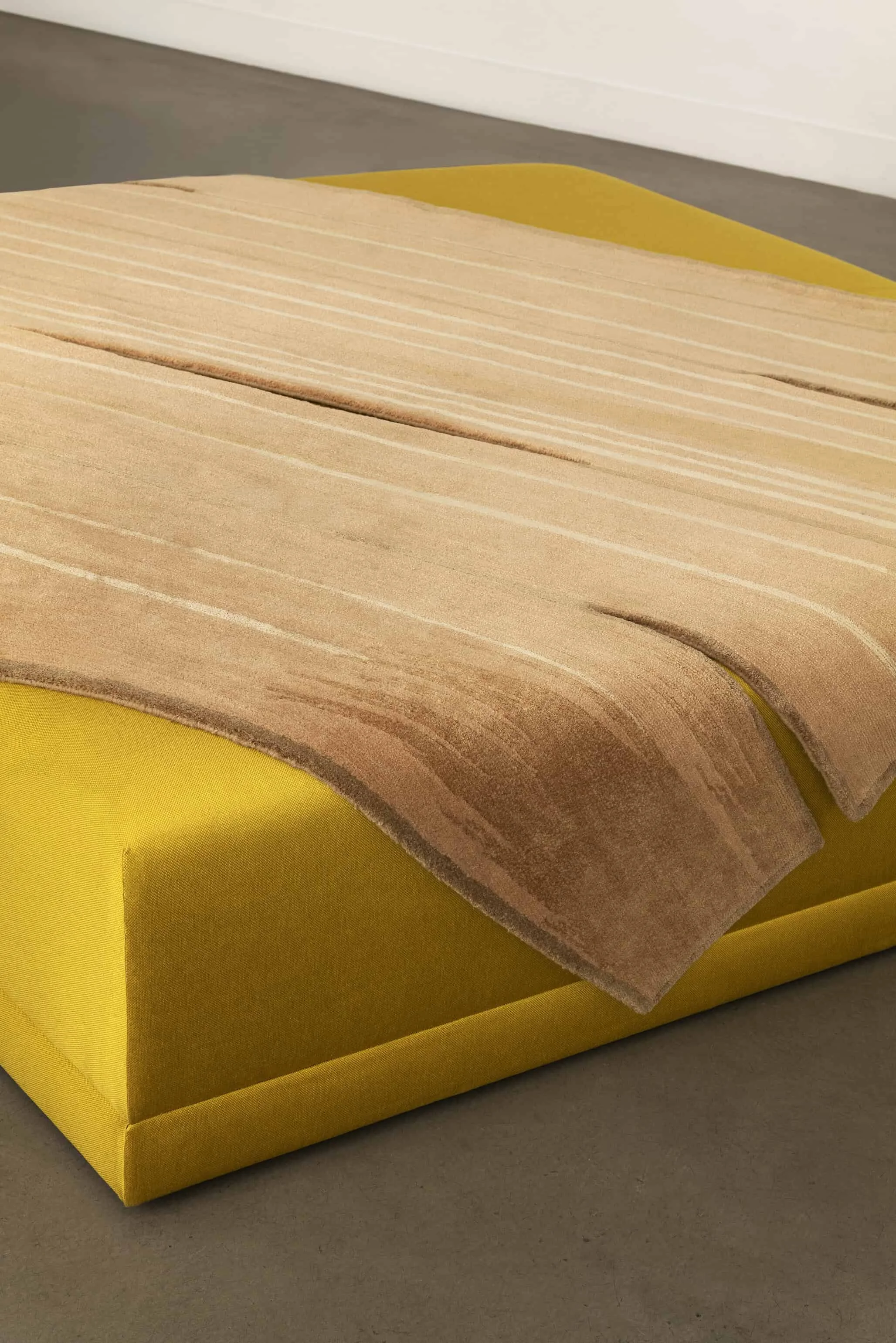
On the evening of May 6, 2026, the Galerie Diurne on rue Jacob in Paris opened the doors of its Quatuor exhibition. Five hand-knotted artisan rugs, designed by artist and consultant Noémi Langlois-Meurinne, hung on walls and lay on floors, somewhere between painting and textile. I had the chance to sit down with her and ask a few questions.

IRK: How did you go from working at Philippe Starck and Louis Vuitton to designing rugs?
I developed my creative sensibility and Interior Design approach in design studios specializing in high-end retail, hospitality, and residential projects. Since every project is unique, it requires the creation of exceptional furniture, rugs, and materials. Custom design, high-quality craftsmanship, and attention to detail have led me to collaborate with many artisans. That’s when I got the idea to design my own rugs.
IRK: How does a painting become an artisan rug?
The paintings, which served as the starting point for the collection, were initially conceived as spaces to be inhabited. I painted a repertoire of evocative forms, windows, crevices, and corners that found a new means of expression in textiles. From this poetics of space arose a desire to explore the possibilities of tapestry.
IRK: Why did you choose imperfect lines instead of straight ones?
I wanted the surfaces to retain traces of the hand that draws them. Imperfection is not a mistake, but a form of expression. I hollow out, carve away, and partially reassemble the material to reveal what unfolds in the background. Through the openings, the beauty of the shadows emerges; they offer a breath of fresh air, a chance to escape.
IRK: Can you use these rugs both on the floor and on the wall?
The rugs in this collection defy the conventions of interior design; they are not intended for domestic use, nor to serve as mere decorative elements where function would take precedence over form. Instead, they find their rightful place at the heart of an open space, or on a surface where the eye can wander freely in contemplation.
IRK: How do you choose between hemp, wool, silk, or linen for each artisan rug?
Each material reacts differently to light and also has its own color palette. For example, I had painted some areas with many different shades, but by choosing hemp, there was no need to transcribe them. Undyed hemp naturally possesses a rich array of completely random tones. I was open to the idea that these high-quality natural fibers would serve as interpreters of my pictorial work.

IRK: What does this rug collection mean to you personally?
It is significant in several ways. This is the first time I am exhibiting under my own name; artistically speaking, the project is entirely personal. It reinforces a strong desire to create a dialogue between my work as an interior decorator and that of a designer and painter.
IRK: How is this project different from your usual work with hotels and luxury brands?
Any hospitality, residential, or retail project involves the collaboration of numerous professionals with artistic, technical, and financial knowledge. It is the combination of all these areas of expertise that enables us to deliver high-end projects. My role as Artistic Director is exciting but collaborative; it requires compromise. Whereas with the Quatuor collection, I maintained control at every stage of development while taking into account the constraints of handmade production.
IRK: Will you design more artisan rugs after this, or is Quatuor a unique experience?
Of course, if the opportunity arises. I’m very interested in exploring the potential of traditional craftsmanship through contemporary creations. I’d love to expand my formal vocabulary with other works, whether on a larger scale or with different functions. Like fragments of the same inner landscape.

The Quatuor exhibition by Noémi Langlois-Meurinne is on view at Galerie Diurne, 45 rue Jacob in Paris, until July 31, 2026. Through these artisan rugs, the artist invites visitors to reconsider textile not simply as decoration, but as a poetic surface where painting, natural fibres, and hand-knotted craftsmanship create a new interior landscape.
Share this post

emotional intelligence, she approaches culture as something to be felt as much as understood, moving fluidly between fashion, music, and the subtle codes that define identity across borders. At IRK, this instinct becomes editorial language, where curiosity is not surface-level but immersive, always searching for what sits beneath aesthetics.
With a background in e-commerce, Elena developed her understanding of digital strategy within a small, human-centered company, working closely alongside neurodivergent teams. The experience shaped her approach to communication and storytelling, grounding it in inclusivity, adaptability, and attention to nuance. These values inform her work at IRK, where content is not only created, but carefully considered in how it connects, resonates, and includes.
Read Next


