

Yoshitoshi Kanemaki’s wood sculptures
Alice Bouju
Sculpting human ambivalence: conversation with the Japanese artist on wood carving, duality, and contemporary humanity
Japanese sculptor Yoshitoshi Kanemaki has developed a singular body of work through haunting wooden sculptures. These are recognizable for their multi-faced figures that seem to exist between stillness and transformation. Interestingly, his wood sculptures capture the complexities of human emotion. Born in Chiba in 1972 and trained at Tama Art University, where he now teaches as a visiting professor, Kanemaki stands today as one of the leading figures of contemporary Japanese wood carving.
At the center of his practice lies a recurring question: “What is a human being?” Through wood carving, Kanemaki explores the contradictions that shape contemporary identity: beauty and unease, stillness and movement, individuality and universality. Influenced by manga, animation, Tokyo’s visual culture, and Buddhist sculpture, his figures appear both familiar and uncanny. As a result, they look as if suspended between multiple emotional states at once. For this reason, his wood sculptures often leave a lasting imprint on viewers.

Paint on camphor
H62 x 20 x 20 cm

Paint on cypress
H30 x 15 x 22 cm
IRK: Your work starts from the question “What is a human being?”. Has your answer to this question changed over time?
Yoshitoshi Kanemaki: While I do feel a gradual shift in my perception of “human beings” through the growth and aging that come with time, my core sentiment remains unchanged: “the differences among us humans appear on the surface, but at our deepest level, we are nearly one.” Individual differences naturally arise from factors such as gender, age, race, nationality, and faith. However, looking at them from a broader perspective, my belief is that we are all fundamentally the same “human.”
IRK: What first drew you to wood carving as your main medium? Is there a particular technique you rely on when you work with it?
Yoshitoshi Kanemaki: Having grown up surrounded by forests since my childhood, wood has always been a very familiar material to me. As a medium, wood contains water and oil, possessing both a robustness that adapts to its environment and a subtle delicacy. I believe these qualities make it the material with the highest affinity for expressing human beings through wood sculptures.
While I increasingly employ my own original processes and techniques, my sculptures are fundamentally rooted in traditional wood carving methods. These methods are derived from Buddhist sculpture and classical wood carving—specifically, ichiboku-zukuri (carving from a single block) and yosegi-zukuri (carving from a joined-block).

Paint on cypress
H75 x 25.5 x 25.5 cm
IRK: You often speak about “ambivalence” in your wood sculptures. How do you translate this feeling into form through carving? Is the balance between realism and strangeness something you consciously build or that emerges naturally while you work?
Yoshitoshi Kanemaki: I believe that “ambivalence” always breathes at the very core of art. “Beautiful yet ugly,” “An impulse within stillness,””Both creation and destruction.” My starting point is the desire to express these contrasting sensations within a single sculpture. Making realism and strangeness coexist within a piece was an approach I consciously began based on a concept. However, I have come to realize that it offers a far greater range of expression than I had ever imagined.

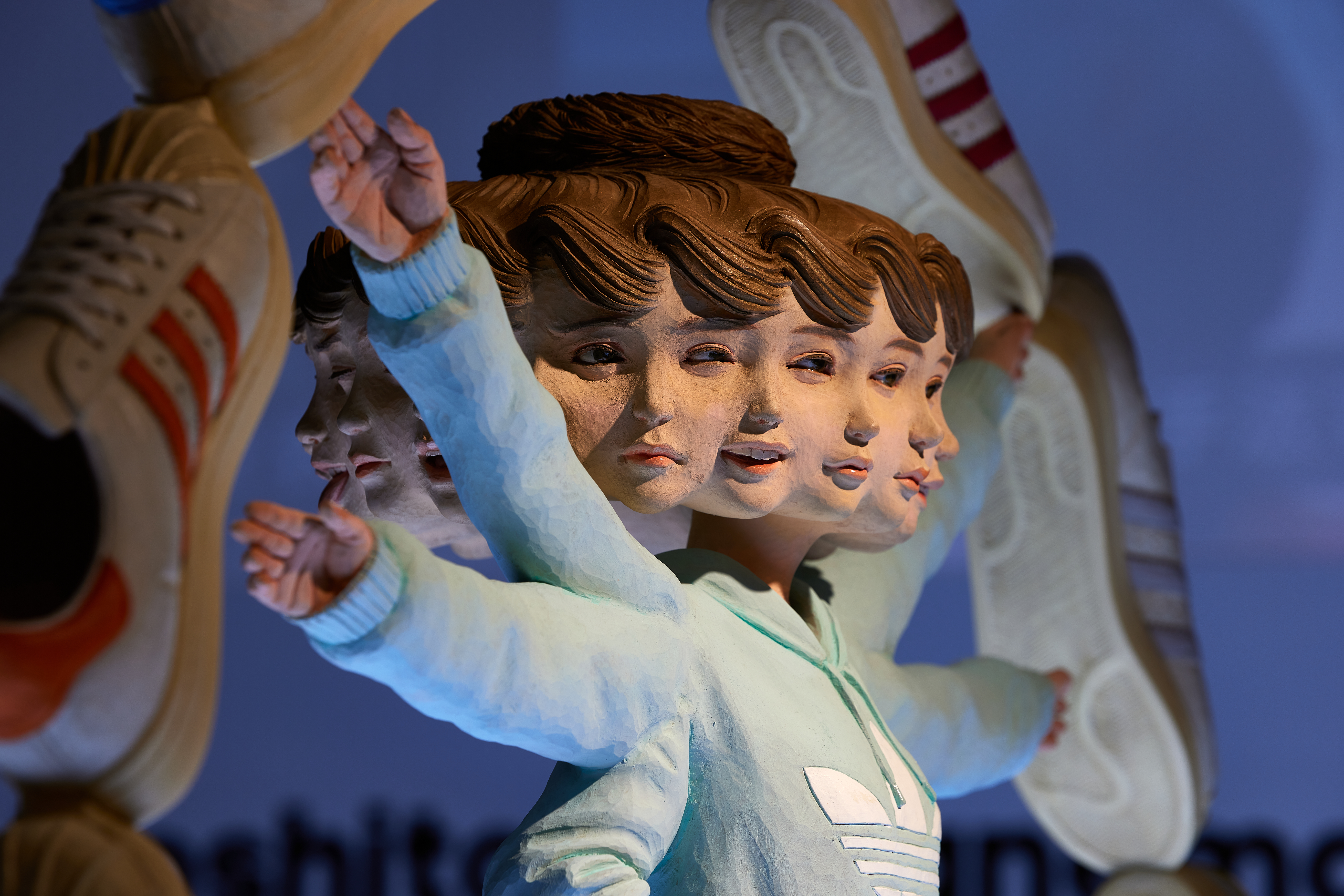
Paint on torreya
H105 x 105 x 22 cm
IRK: Are there particular artists, images, traditions, or personal memory that have influenced your work?
Yoshitoshi Kanemaki: Everything is connected to how I arrived at the work I create today. My own way of life, the people I have met, the books I have read, the films I have watched, numerous works of art, and countless other experiences. While it is difficult to capture all of it in a few words, I have been deeply influenced by manga such as “Osamu Tezuka’s Phoenix,” “the animation of Yoshiyuki Tomino,” and “Buddhist sculptures with unconventional, otherworldly forms.”

Paint on camphor,
H65 x 27 x 31 cm
IRK: How do you usually begin a wood sculpture: from a clear idea, a sketch, or directly from the material itself? And what do you use when you add the final colour and finish?
Yoshitoshi Kanemaki: I keep myself constantly tuned to catch even the subtlest, freshest stimuli. Whenever I sense the beginnings of a new idea, I often jot down words in my mobile’s notes or draw in my sketchbook. There is no fixed routine for how I begin a piece. I make use of whatever tools serve the process. This could mean drawing sketches, creating maquettes out of clay or Styrofoam, or studying forms using 3D CG. For the final color and finish, I typically use acrylic paints and wood varnish.
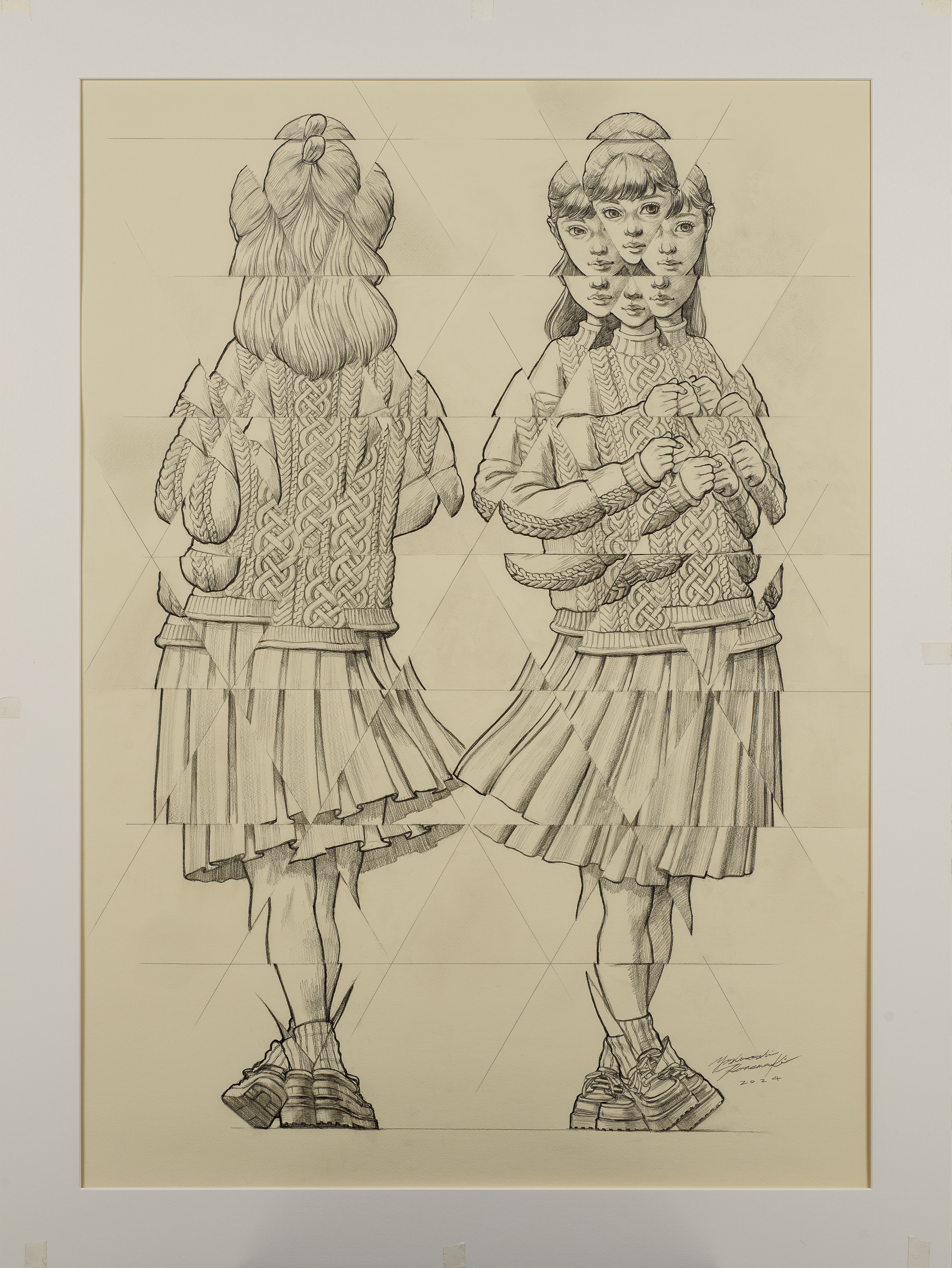
Pencil on paper
100 x 72 cm
IRK: What do you hope viewers feel or notice first when they encounter your wood sculptures in person?
Yoshitoshi Kanemaki: We live in an era of fast-moving information overload, where photos, music, and videos constantly stream through the palms of our hands. In the midst of this, I hope viewers can sense the significance of what might be considered the slowest medium of all, patiently and steadily crafted sculpture.
My sculptures also carry the aspect of being “portraits of contemporary humanity.” When viewers stand face-to-face with a piece, I would love for them to connect with it personally. They might ask themselves, “Is this someone I know well? Or could it be me?” By turning their thoughts to the background and stories behind these figures, they might just become aware of the ambivalence of the times we live in.

Paint on Japanese nutmeg and katsura
H170 x 72 x 67 cm
Share this post

Alice is a Paris based photograper with a passion for fashion. Based in Paris, she develops an approach that brings together photography and writing, often mixing the two within her projects.
Her work is deeply rooted in reality. She is particularly drawn to documentary practices, using images and text as complementary tools to observe, question, and reinterpret the world around her. Whether through visual series or written pieces, she seeks to capture fragments of the everyday and give them a new narrative dimension.
She has developed a strong interest in research and editorial work. Writing articles, exploring contexts, and building stories from real-life subjects naturally extend her creative process. This intersection between documentation and storytelling reflects a field she has long been eager to explore.
Read Next


