

British Pullman, More than A Belmond Train Journey
Anji Connell
Wes Anderson brings his unmistakable cinematic eye to Cygnus; Baz Luhrmann and Catherine Martin conjure the fantastical world of Celia. Aboard British Pullman, almost a century of history meets contemporary storytelling, exquisite craft, ever-changing light and shifting views, and the glorious pleasure of dressing up and going nowhere in particular.
There are journeys for which you pack sensibly. This is not one of them. Because you don’t simply board the British Pullman. You enter its world.
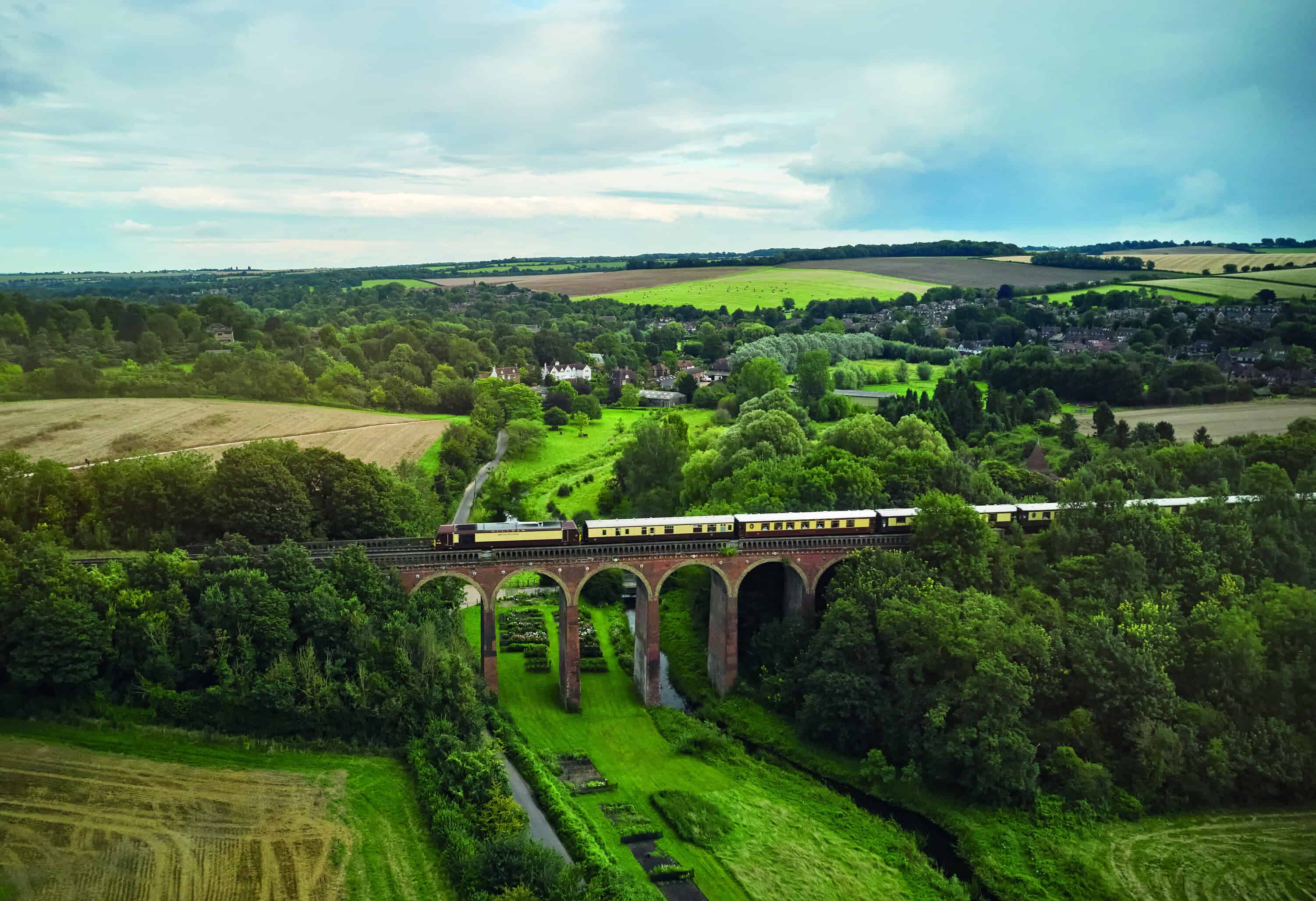
Ours begins in Audrey, a 1932 carriage built for the Brighton Belle that has carried Queen Elizabeth II, the Queen Mother and the Duke of Edinburgh. Today, it is carrying us to precisely nowhere. We are having Sunday lunch while travelling through the English countryside before returning to London Victoria.
It is wonderfully pointless.
How to dress for a Belmond Train journey
Inside Audrey, polished timber, brass, upholstery and intricate marquetry create a richness that feels almost cinematic. Lunch arrives. Bubbles shimmer in suitably heavy crystal glasses, we don’t want them spilling as the train gathers pace, while the stewards somehow glide through a dining room moving at speed.
Outside, England keeps changing costume. Green fields become villages, gardens, rooftops, sky. Simultaneously sunlight flashes through trees and across the carriage, catches a mirror, disappears, returns somewhere else. The light continually redesigns the interior. And everyone looks rather good in it.
There is something deliciously old-fashioned about dressing beautifully to travel slowly. The train becomes a stage and, for an afternoon, we are all part of the mise-en-scène.

Attention to Detail
Then Keith appears. Lively, warm and brimming with stories, he knows the train inside out and clearly adores it. Presently he escorts me through the carriages: he points out details, histories and little oddities with the kind of enthusiasm that makes you look again. That pride is infectious.
The service throughout is beautifully judged, polished, but never stiff, and Keith embodies that perfectly. He doesn’t make the train feel precious, instead makes it feel alive. And then he opens the door to Cygnus.
Wes Was Here
Cygnus is so unmistakably Wes Anderson that you almost expect Adrien Brody to appear at the other end of the carriage. Symmetry. Geometry. Green. A pale pink ceiling. Angular mirrors. Swans hiding in the detailing. Marquetry depicting sunbeams, clouds, stars and waves.
Anderson, who has invented more than a few imaginary railway worlds on film, described the project as an opportunity “to make something new while also participating in the process of preservation.” More wonderfully, he calls this kind of train travel “an endangered species” that remains peculiarly suited to our time. He is right.
Cygnus is meticulously composed, but the real world refuses to obey the composition. Light flickers across it. Trees flash past. Reflections appear and vanish so that the English countryside becomes a constantly changing film outside the window.
From Cygnus, subsequently Keith leads me on to the newest fantasy aboard the train. Celia.


Meet Celia
Firstly Celia doesn’t exist. Except she does.
Baz Luhrmann and Catherine Martin invented her: a glamorous 1930s West End actress whose performance as Titania in A Midsummer Night’s Dream captures the heart of her future husband. Besotted, he commissions a private Pullman carriage in her honour. Naturally. This is Baz Luhrmann.
Celia is less carriage than character: flowers, mirrors, rich textiles, extraordinary marquetry, jewel-like surfaces, a glamorous bar and a lounge that can transform into a dining room, cocktail salon, performance space or dance floor. If Cygnus is exquisitely controlled, Celia has kicked off her shoes.
Luhrmann says trains can put us into “a dream-like state where you forget about the realities around you in the world.” Celia takes that idea and runs with it. Surprisingly, even the ceiling changes colour, shifting the atmosphere between day and night. Luhrmann imagined a place for “a performance, a DJ, someone singing an unplugged song, or a speech.” It is theatrical, decadent and deliberately escapist.
And there is something rather fashion-like about the way Luhrmann and Martin have approached it: character first, then identity, colour, pattern, texture, embellishment and drama. Ultimately, Celia is dressed, not decorated.
And beneath all that fabulousness is craft.

Made by Hand
The marquetry connects Celia to a story considerably older than her fictional heroine. A. Dunn & Son made original marquetry for Pullman and Wagons-Lits carriages in the 1920s and 30s. Four generations later, the same family workshop has worked on Celia.
Its fourth-generation custodian describes what separates their work from computerised production beautifully:
“With our marquetry, you would be able to see the human touch, unique quirks, flaws that are not possible to replicate by machine.”
Her favourite project? Celia. “She is so overwhelmingly stunning; her beauty, her elegance, is a project I was immensely proud to be a part of.”
And then she says something that suddenly makes this gloriously eccentric afternoon feel surprisingly contemporary. “We are living in a world of instant gratification and AI. We are missing out on the fundamental need to create with our hands.”
Perhaps that is why the British Pullman feels so seductive now. Everything about it requires time. Time to make, to maintain, to serve, to eat, to look. Time even to get dressed for nowhere.
British Pullman gives us Memories in Motion
Eventually London begins appearing outside the windows. There is a faint end-of-party sadness. Although we have spent hours traveling, we have ended exactly where we began. Perhaps luxury isn’t always about acquiring something new.
Sometimes it is simply having the time, and the imagination, to make a memory. Preferably while beautifully dressed.
Share this post
Anji Connell is an internationally recognised interior architect, garden designer and self-proclaimed nomad. Known for her fabulous persona and her even more exquisite taste in all things design. She regularly writes for a variety of International titles on subjects such as art, design, lifestyle and travel from her globe-trotting adventures.
She divides her time between London, Hong Kong and South Africa.
Read Next


