Dustin Shuler: Spindle – Cars into Sculpture
Samuel Kaur
Dustin Shuler (1948–2010) was an American sculptor known for turning everyday objects, especially cars (the Spindle), into large artworks that asked questions about culture, consumption, and space.
Dustin Shuler made work that was not quiet or small. Instead, he placed familiar things in unfamiliar positions so viewers had to think about them again. The Spindle was one such works. Where Shuler used stacked cars in surprising way making his mark on public art in the United States.
Early Years and Path to Art
Shuler was born in Wilkinsburg, Pennsylvania, and studied art while working in a factory. He took night classes at the Carnegie Institute of Technology, now part of Carnegie Mellon University. In 1971, he left factory work to pursue art full time. A few years later, Dustin Shuler moved to Southern California and began making work that used large found objects, especially automobiles.
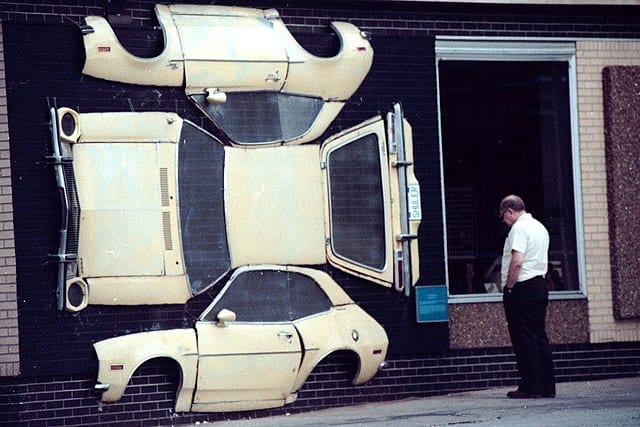
Shuler learned welding and metalwork early on, and these skills helped shape his art. In his first major pieces, he pierced, skewered, or re‑arranged car bodies to make new forms. Dustin Shuler did not follow traditional sculpture methods; he treated cars as raw material. The car body became surface, symbol, and shape, all at once.
Key Works and Ideas of Dustin Shuler
Shuler became best known for his large outdoor installations. His work often stood in public places rather than galleries or museums. In this way, it reached people who might not normally visit art spaces. Many of his most visible works involved cars, nails, or both.
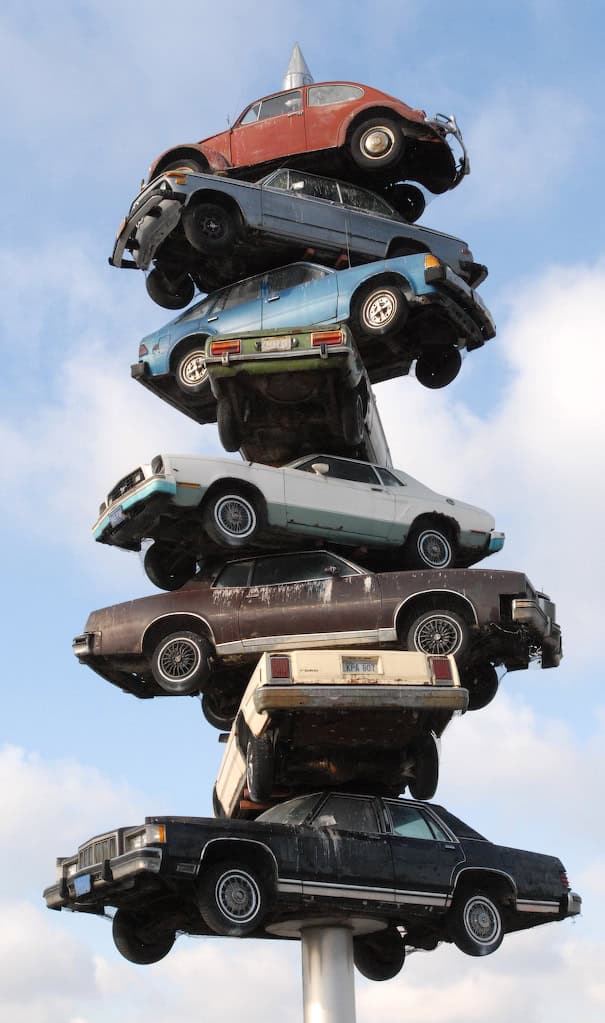
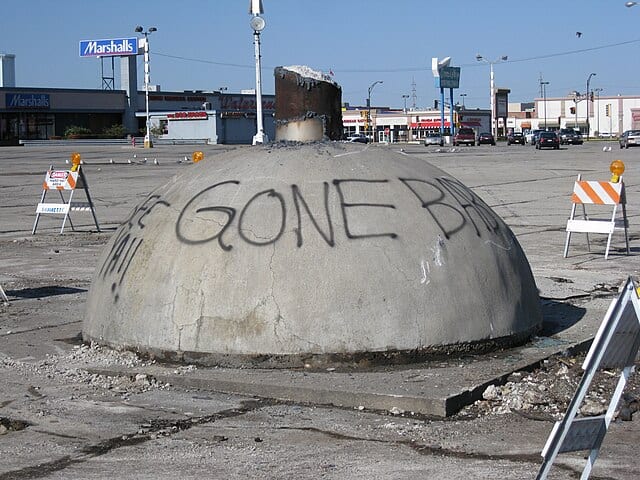
In 1989, Shuler created “Spindle”, perhaps his most famous piece. “Spindle” was a 50‑foot tall steel spike with eight cars impaled on it like notes on a desk spindle. The sculpture stood in the parking lot of a shopping center in Berwyn, Illinois, for nearly 20 years, and it became a local landmark. Right from the start, “Spindle” stirred debate. Some people embraced the sculpture. They said it brought character to the shopping center and even boosted business. The mall’s owner claimed that the odd artwork drew more visitors than other local centers. Meanwhile, many local residents disliked the installation, calling it strange or out of place. Early on, a city vote showed that many wanted it removed.
Over time, “Spindle” gained wider notice beyond Berwyn. It appeared in the 1992 film “Wayne’s World” and was featured on postcards and tourist brochures. Some people even nicknamed it “the car kebab,” because the cars on the spike resembled pieces of meat and vegetables on a skewer.
Beyond Cars
Although cars dominated much of his work, Shuler also explored other materials and formats. In 2006 he created “The Rainforest: A Landscape in the Shower”, a living installation that combined plants, animals, and water systems inside a clear enclosure. This piece showed a different side of Dustin Shuler’s practice, one that looked at life systems rather than metal and machines.
He also made “Dance” in 2007, an installation of twelve cars arranged in a circle and lifted with steel cables. This work moved away from impalement and toward form and rhythm. “Dance” appeared in Sarasota, Florida, as part of an outdoor sculpture season.
Public Presence and Dustin Shuler‘s Legacy
Shuler’s art occupied spaces that invited public interaction. He exhibited work in shopping centers, college campuses, and city sites. Many institutions, like the Ulrich Museum of Art in Wichita and museums in California, added his work to their collections. He showed that art could exist outside museum walls and still shape how people thought about objects and places.
Shuler died of pancreatic cancer in 2010 at his home in Inglewood, California. After his death, people remembered both his humor and his drive to reframe the ordinary. He asked viewers to reconsider familiar things like cars, nails, even landscapes, outside their usual context. Today, his work remains part of discussions about how art interacts with everyday life and the public realm.
Read more about Dustin’s biography here.
Share this post
Samuel is a Paris-based creative marketing student and writer. When he got bad grades in school or behaved badly, his parents punished him by making him read - maybe that's where it began. What felt like torture at the time has now turned out to be a great gift.
Two years ago, he moved to Paris for his fashion studies. Since then the urge to write has only grown stronger. When he's not working on articles, he writes mostly film scripts or poetry. Beyond writing, he has a deep-rooted passion for cinema and enjoys engaging in all forms of filmmaking.
Read Next