Radius and Resonance – Michael Legan
Patrick Duffy
Michael Legan on Designing Objects That Listen
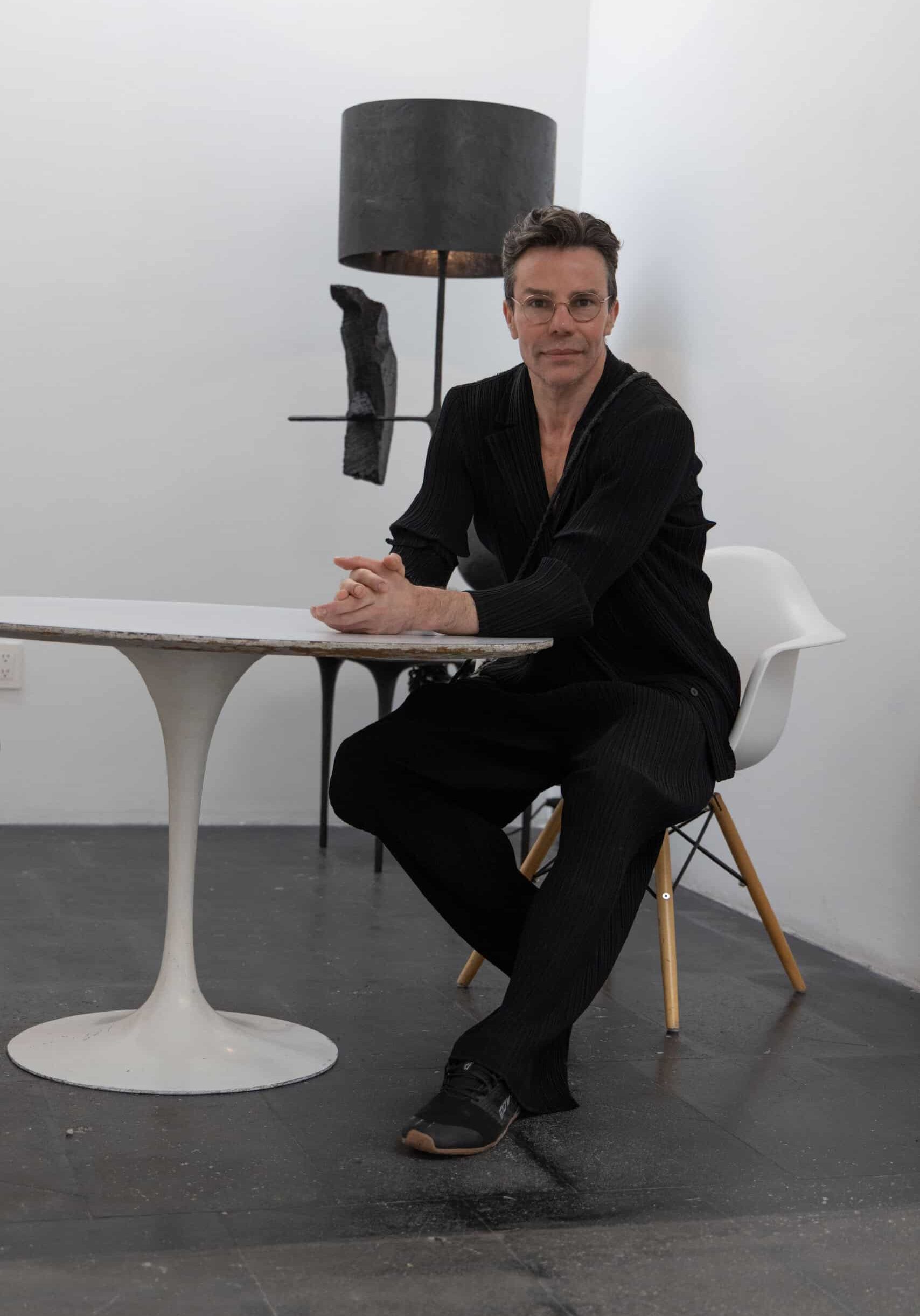
Michael Legan is a Minnesota-based designer whose work moves fluidly between sound, structure, and sculpture. Additionally, he is rooted in his training as a musician and shaped by years of composing for both commercial and experimental contexts. As a result, Legan brings a composer’s sensitivity to proportion, rhythm, and tension into the physical world of objects. Through MEL, his furniture company, he translates this sensibility into thoughtfully crafted pieces that reflect the same attention to structure, balance, and form.
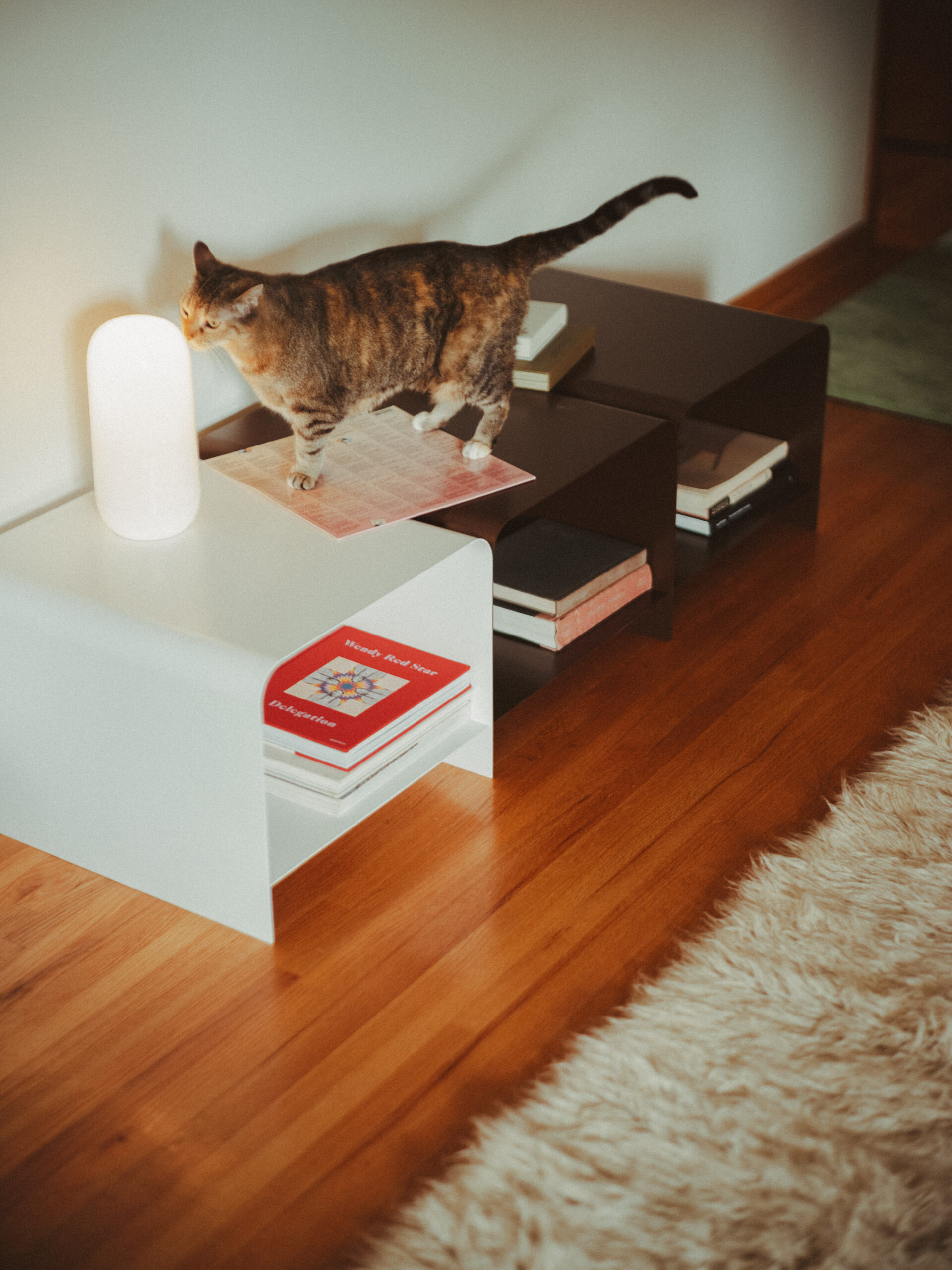
His Radius Table reflects this lineage. In this sense, defined by softened steel curves and a quiet sense of balance, it feels less like a first statement than the continuation of a long and thoughtful practice. Moreover, what once unfolded through sound now occupies space. Consequently, a sensibility refined over time is translated into form.
When we talk, Legan is quick to point out that this path never felt like a pivot. “It’s actually been a gradual, slow process,” he says. “Likely beginning when I was a kid.” Meanwhile, growing up in Minnesota, he spent countless hours next door in the garage of a neighbor who made furniture, a physicist mathematician who worked at Honeywell. For example, “I remember going over there literally all the time to watch him work. We’d make stuff together like rubber band guns, a useless object I had in my head that I wanted to make, and he’d help me make it.”
There were treehouses, a go-kart, and a pinewood derby car. At the same time, Legan was taking piano lessons and recording short compositions onto a tape player. “I’d record ideas, then walk next door to work on something physical,” he recalls. Even then, sound and structure were developing in parallel, quietly feeding one another.
Michael Legan and the Discipline of Constraint
Later, in his twenties, Legan entered the world of commercial music composition, a discipline defined by constraint. “You’re constantly working within tight boundaries,” he explains. “File formats, broadcast standards, tempos, duration, genres.” Rather than limiting his creativity, those constraints sharpened his instincts. Over time, this led to sound installations, environments designed to heighten awareness of space and listening. “I was always testing ideas against material reality,” he says. “Solving problems for a 30 second spot or figuring out how to make a room resonate in a particular way.”
As a result, when fabrication reentered his life in his early thirties, it felt familiar. “The same iterative process,” Legan says. “The response to a line or curve and a note or chord are completely transferable. They’re both about tension, resolution, proportion. About how elements relate to each other in space or time.”
Legan on Waste, Process, and Iteration
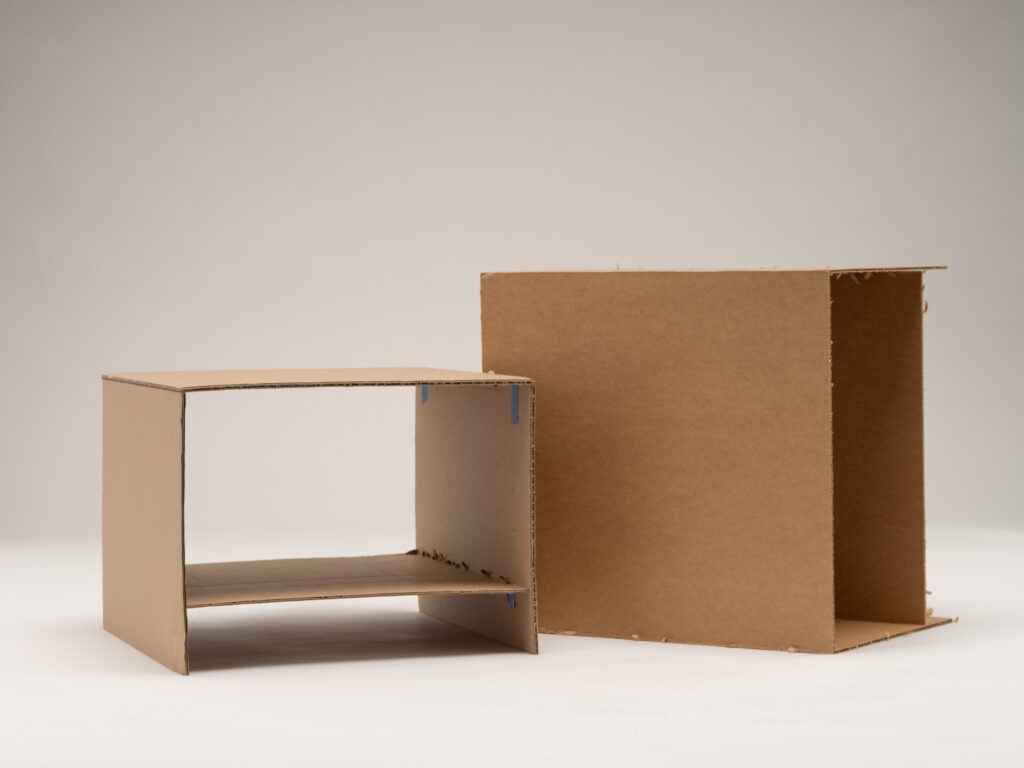
The Radius Table emerged not only from this background, but also from a growing discomfort with waste. While working in a fabrication shop producing museum pedestals, exhibition infrastructure, and shipping crates for artwork, Legan became acutely aware of inefficiency baked into custom work. “By the end of a project, I’ve almost always made a custom jig or tool for one specific function,” he says. “Then the job is finished and I never look back. The next project demands a different process, so I start over. That’s the nature of custom work, but it’s also wasteful.”
By contrast, music offered a revealing alternative. “With music, discarded material doesn’t take up space,” he notes. “It doesn’t require energy to dispose of. Improvisation and revision happen on a more condensed timescale.” This realization became foundational. “This is partly what set MEL into motion,” Legan explains. “The desire to keep processes iterative. To keep the jigs in circulation.”
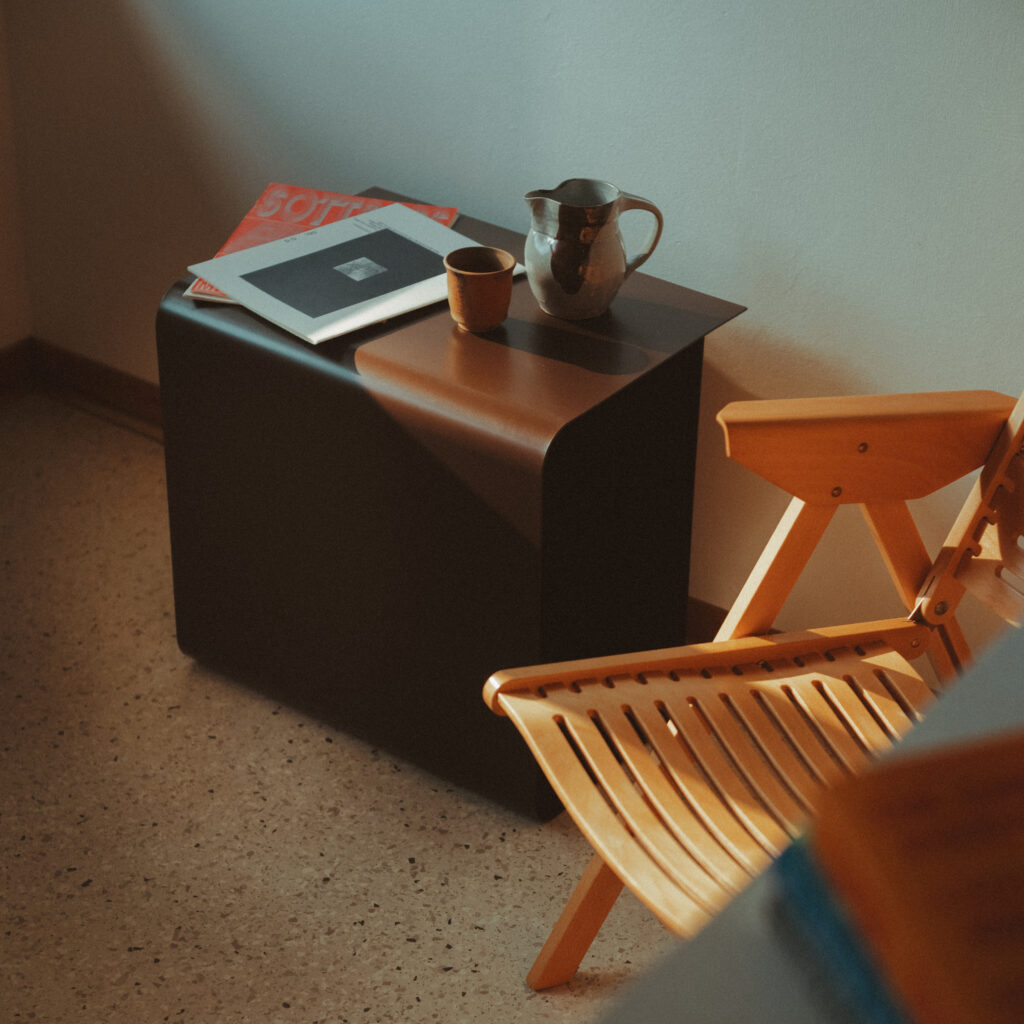
Radius Table in the Post-Digital Design Movement
This way of thinking places Radius Table deliberately between handwork and industrial production. In this context, Legan often references Donald Judd. “Even though Judd worked with manufacturers, the scale was never high volume,” he says. “As a result, his furniture wasn’t accessible to most people.”
Radius Table was designed as a response to the present moment. “Our uncertain economy. The precarious job market. The overwhelming presence of AI, new tech, screens,” Legan says. “I wanted to design something more affordable than a custom one-off, but without sacrificing quality or intent.”
This question sharpened during a recent trip to Stockholm. Traveling with his partner Naomi Crocker and friends Julka Almquist and Oskar Laurin, Legan spent time at Konst-ig, an independent art and design bookstore founded by Helene Boström. The space is compact and dense, shelves packed tightly with art books, theory, small press publications, spines layered like a quiet archive of resistance. It is a place that slows you down without asking.
Over conversation, Boström mentioned a detail that stayed with him. Konst-ig opened in the same year as Amazon. “These two entities born of the same time that ultimately went in very different directions,” Legan says. The contrast lingered. “It became clear that we need physical books more than ever as a counterweight to digital saturation.”
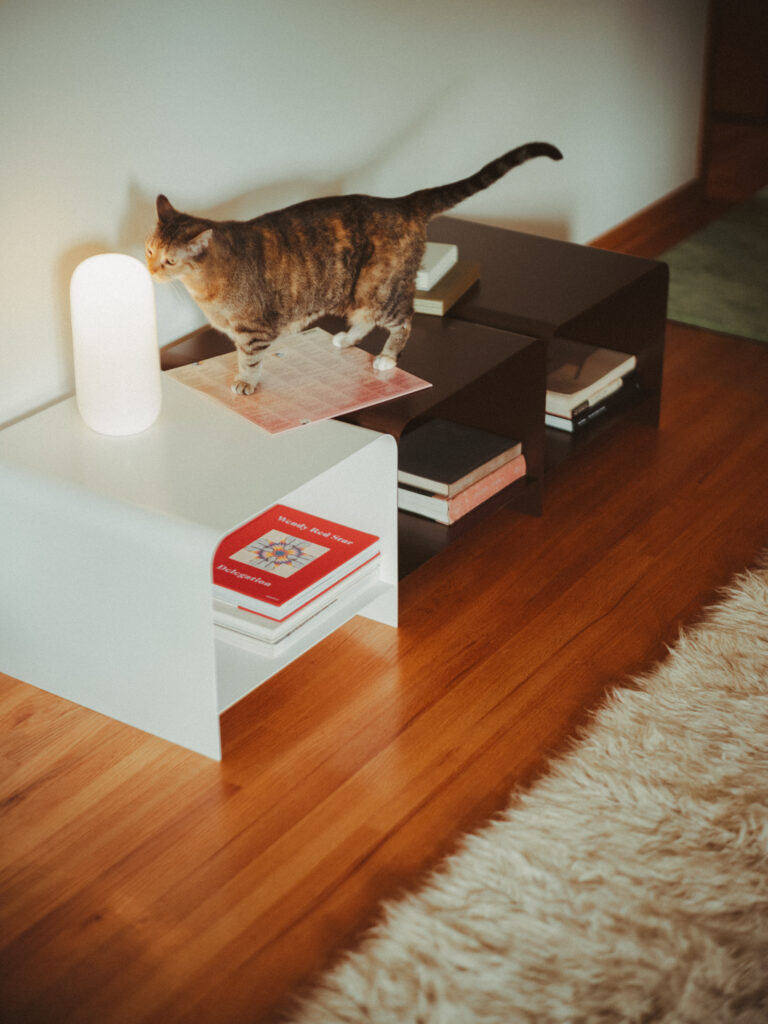
Radius Table carries that realization without declaring it. By holding books, it draws them into daily life, giving both literal and figurative weight to the objects we return to again and again.
Materiality and Craft
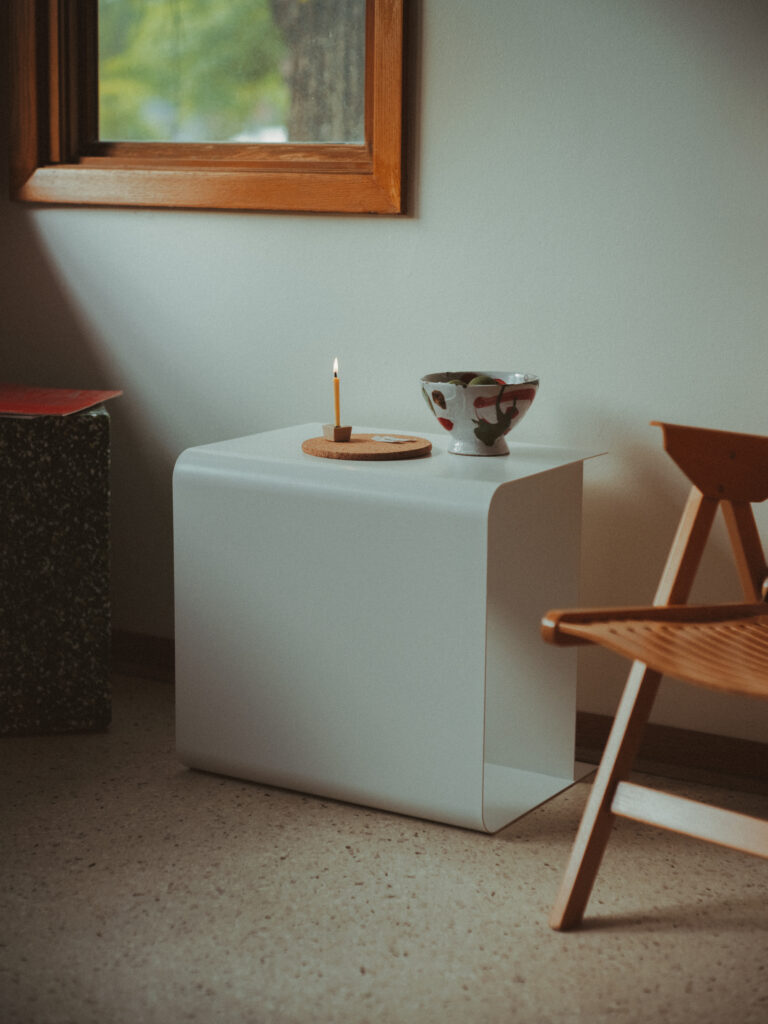
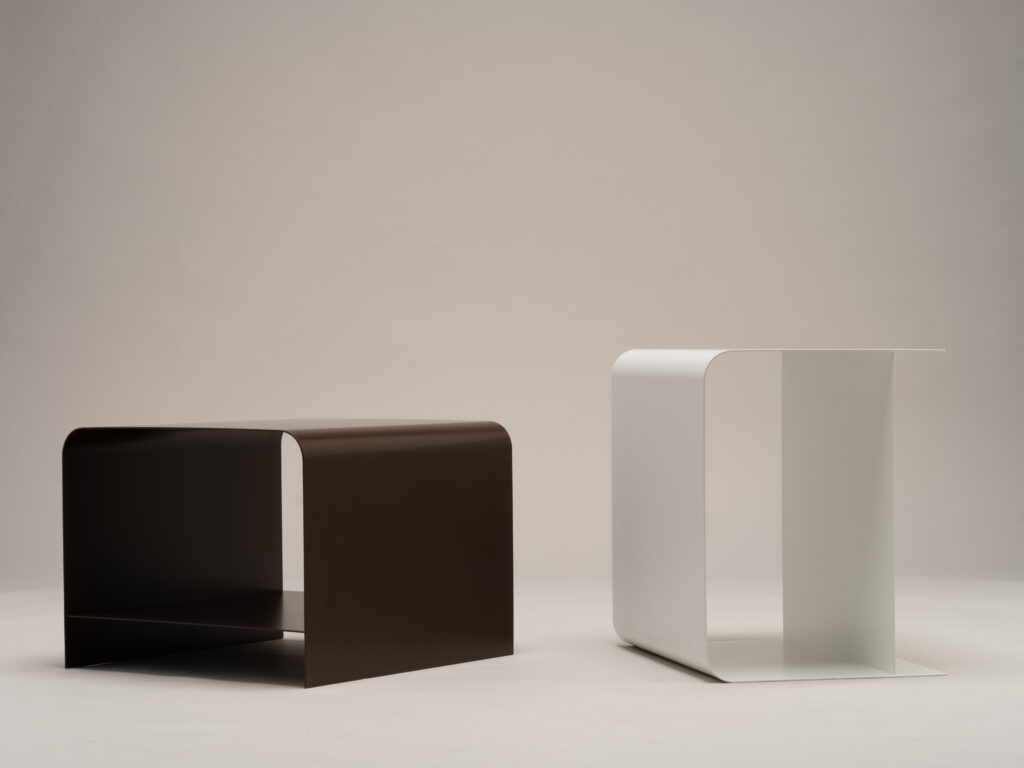
Steel, Legan says, “made the most sense.” Durable, abundant, highly recyclable. “It’s an honest material. It’s not pretending to be something else.” However, what gives the table its character is softness. “The bends in the steel push perception,” he explains. “It takes a material people perceive as hard or industrial and introduces a gentleness you might expect from bent plywood.”
Furthermore, those curves are technically demanding. “Steel resists bending,” Legan says. “Making it yield gracefully requires precision and patience.” Radius Table was also his first collaboration with a contract manufacturer whose primary work involved medical devices and municipal infrastructure. “They bring a pragmatic perspective,” he notes. “They aren’t immersed in design objects all day, and that’s actually an advantage.”
Design, Function and Presence
One decision, in particular, nearly broke the process. “Almost everything that gets powder coated has a hole in it so it can be suspended,” Legan explains. “I didn’t want a hole in the table. Once it’s in someone’s space, it wouldn’t serve a purpose. And it would immediately demand attention without justification.”
For this reason, Radius Table is intentionally un-ornamented. “I want people to feel uncomplicated by it,” Legan says. “It’s meant to be a resting place. For books, for objects, for daily life.” Sculpture, in the precious sense, is secondary. “The care should be something you sense, not something you’re asked to admire.”
As our conversation winds down, we talk about perfection. “I’m haunted by perfection and propelled by feeling,” he says. Lately, he has reframed perfection as desire itself. “Not the desire to achieve perfection, but desire as the force that moves the work forward.”
That idea stayed with me the first time I encountered Radius Table in person at the Walker Art Center Idea House, the museum’s design-focused space dedicated to artful, well-considered objects. Surrounded by works that often ask to be noticed, Radius Table did something else entirely.
What struck me was not its form, but how quickly it disappeared into use. A book placed casually. A hand resting on its edge. It did not interrupt the room. It steadied it. Within minutes, we were talking about something else entirely, which felt like the point.
Legacy and Contemporary Intention
Legan smiles when I describe the moment. “I want people to feel uncomplicated by it,” he says. “It’s meant to be a resting place. For books, for objects, for daily life.” Sculpture, in the precious sense, remains secondary. “The care should be something you sense, not something you’re asked to admire.”
The table’s presence at the Walker feels fitting. Radius Table sits comfortably within a broader movement toward post-digital, materially grounded design that values restraint, longevity, and use over spectacle. Consequently, it belongs to a lineage of objects that do not announce themselves, but endure through attention, touch, and repetition.
Legan is currently working on a bookshelf, an object conceived entirely around the analog act of reading. “That feels important right now,” he says.
Not as nostalgia, but as intention. In Legan’s work, objects are not arguments against technology or speed. Instead, they are companions within contemporary life. Designed to hold space. To support attention. And to quietly remind us that care, when practiced deliberately, can still shape how we live.
Share this post
Patrick Duffy is the founder of Global Fashion Exchange, a company catalyzing positive impact through strategic consulting roadmaps focusing on supply chain transparency, worker rights, responsible production for B2B as well as consumer facing programming and community building focusing on aligning people or communities with the SDGs.
Experience developing networks and activating ideas, guiding creative teams globally, and working with institutions like the Victoria and Albert Museum and UNESCO, and iconic spaces such as Federation Square Melbourne, Madison Square Garden, Bryant Park in New York City, and The Dolby Theatre in Los Angeles.
Patrick has produced clothing swaps all over the world from, with GFX Active in over 100 countries. Each GFX event focuses on building community, education and transformational business models. Partnering with global brands, key stakeholders, and academia to help create awareness and positive impact through conscious consumption
Patrick harnesses the power of media to create positive social and environmental impact. Through storytelling, education, and advocacy, he raises awareness, inspires action, to catalyze change. By highlighting issues and solutions, Patrick creates strategic campaigns to engage audiences, influence attitudes and behaviors, and contribute to a more sustainable and just world. Additionally, Patrick is the Sustainability and Positive Impact Director of Paris based @IRKMagazine and Editor In Chief of @IRKLiving
Patrick has produced and co-curated events and marketing/PR campaigns for recognized brands across art, fashion, and tech spaces including @virginhotels @britishfashioncouncil @mspdid @moethennessy @microsoft @lagosfashionweekofficial @perutradenyc @fashionimpactfund @istitutomarangonidubai @peaceboatus @lisboafashionweek and more spanning 15 years and hundreds of events in 5 continents.
Read Next