Van Beirendonck FW 2026-27
Mia Macfarlane
SCARE the CROW / SCARECROW, A WALTER VAN BEIRENDONCK COLLECTION
To begin with, breaking rules has never served as decoration for Walter Van Beirendonck. He uses it as a method. Accordingly, this season places clowns, gender fluidity, and youth at the centre rather than the margins, and this unique approach is a hallmark of Walter Van Beirendonck’s collections.
“I have always felt like an outsider in this industry.” However, Van Beirendonck does not frame that distance as rejection. Instead, he uses it as a vantage point. Notably, he draws inspiration from Art Brut and Outsider Art with renewed urgency.
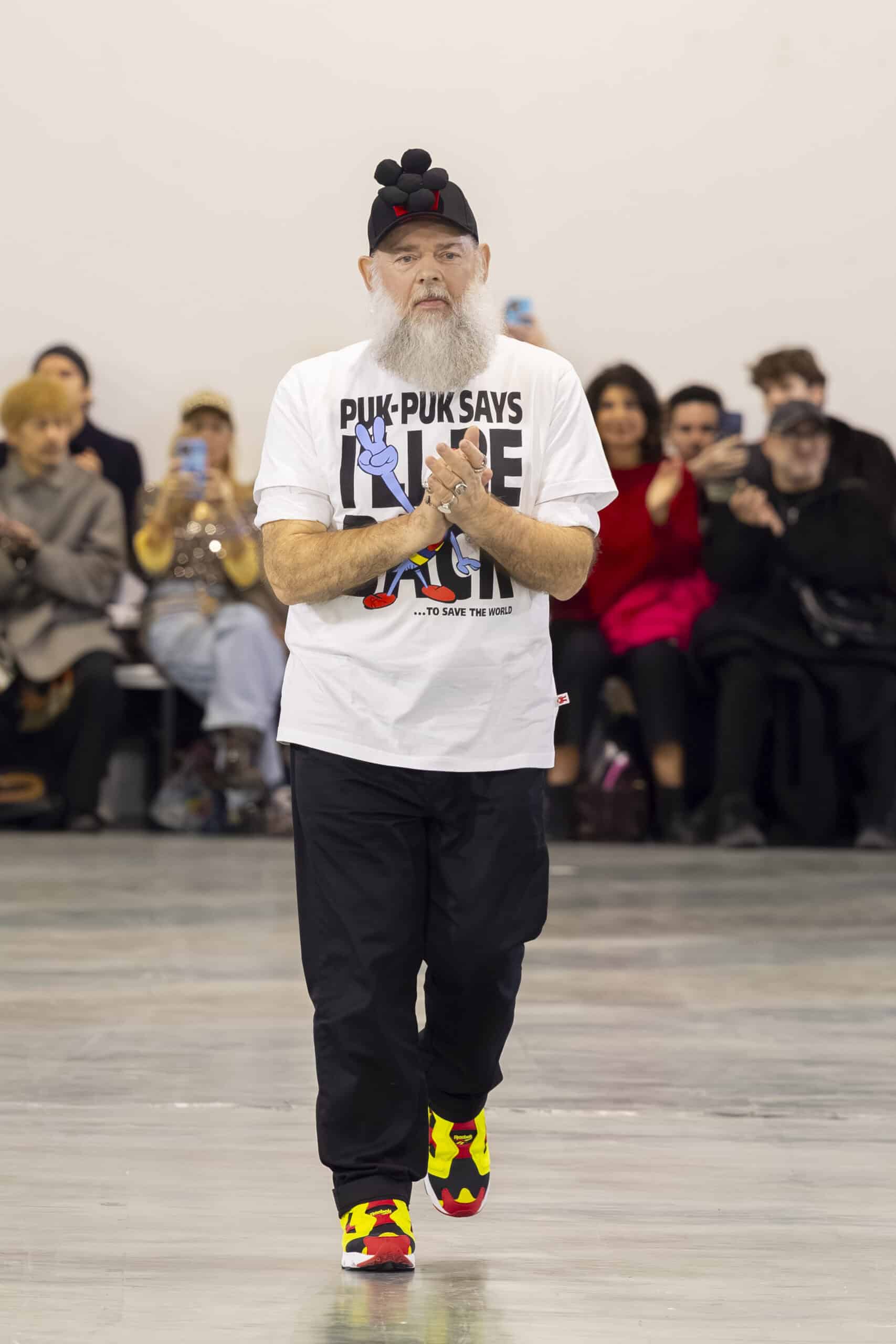
A Position Taken
At the heart of the season sits a declaration that frames everything that follows:
“I have called this collection SCARE the CROW / SCARECROW. Perhaps because a scarecrow stands alone, assembled from whatever is at hand, trying to look human. Subcultures, as we once knew them, have disappeared. What you see here are the Scarecrows of 2026.”
This is not a metaphor for effect. Rather, it functions as a diagnosis. Youth today builds identity from fragments, not movements. As a result, garments here assemble themselves from contradiction, memory, and improvisation.
Art Brut and Raw Instinct
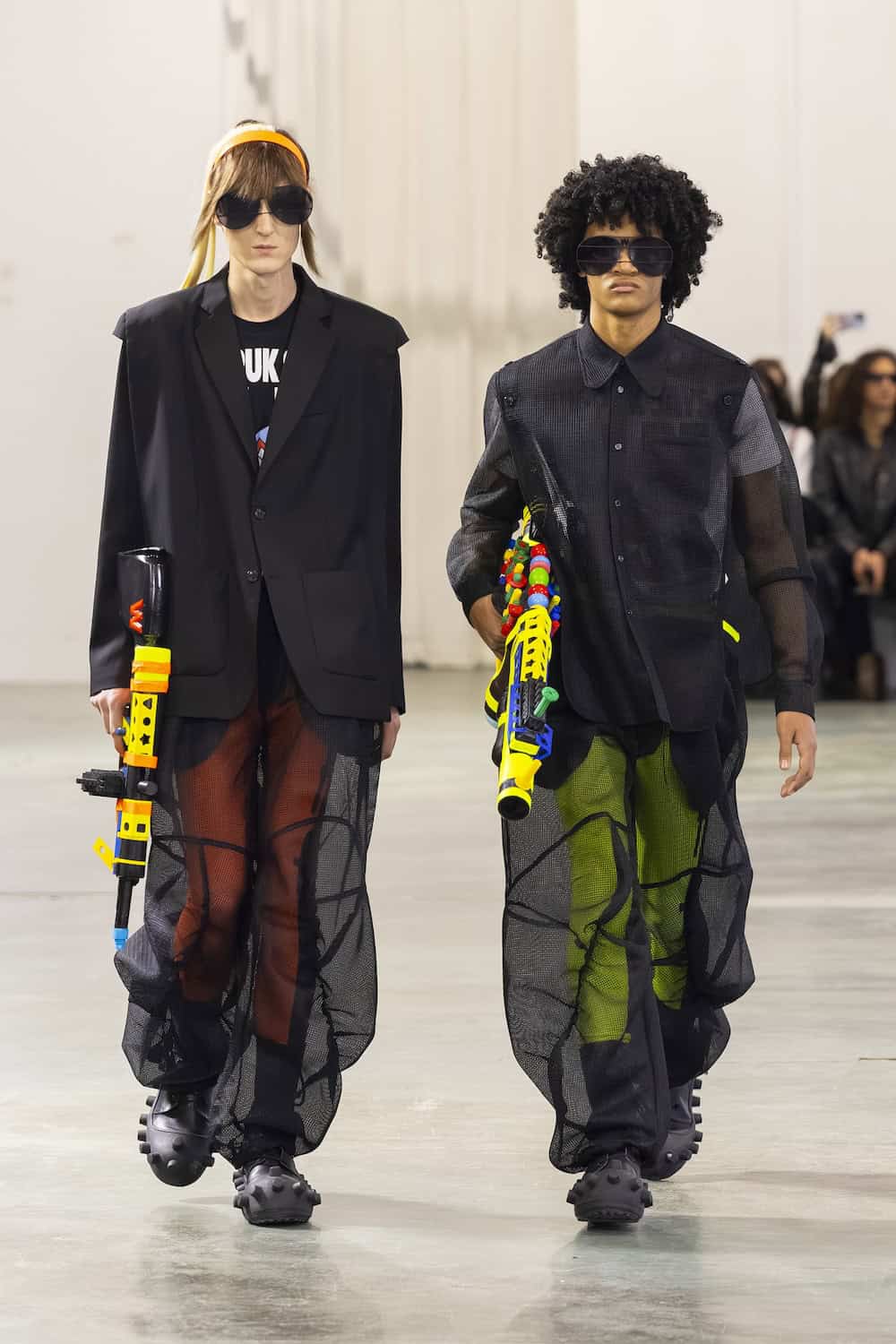
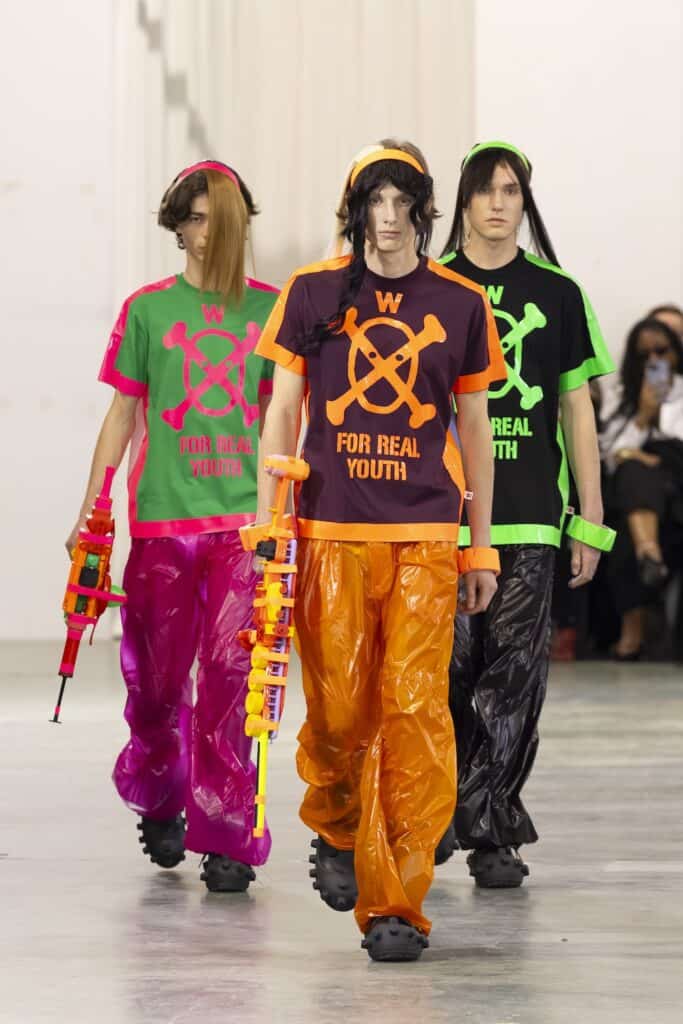
In particular, Van Beirendonck turns to André Robillard, whose hand-built weapons, assembled from wood, tape, and found objects, reject polish and permission. As a result, the work carries emotional weight rather than refinement. A quality central to Walter Van Beirendonck’s vision.
That instinct mirrors childhood. Before self-consciousness intervenes, emotions translate directly into drawings, objects, and clothes. Consequently, youth appears here as raw energy rather than nostalgia, which aligns with Van Beirendonck’s artistic philosophy.
Aggression Meets Tenderness
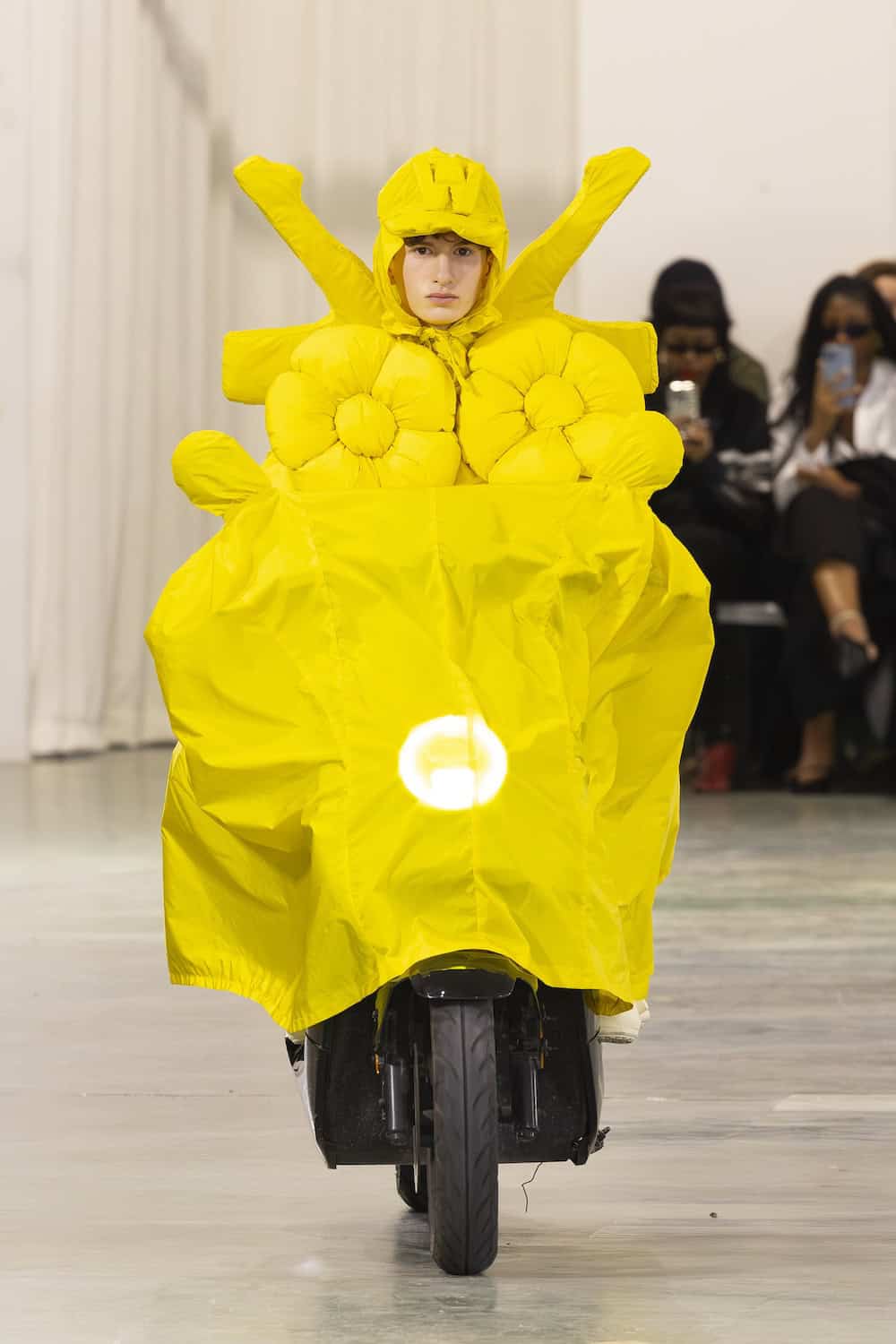
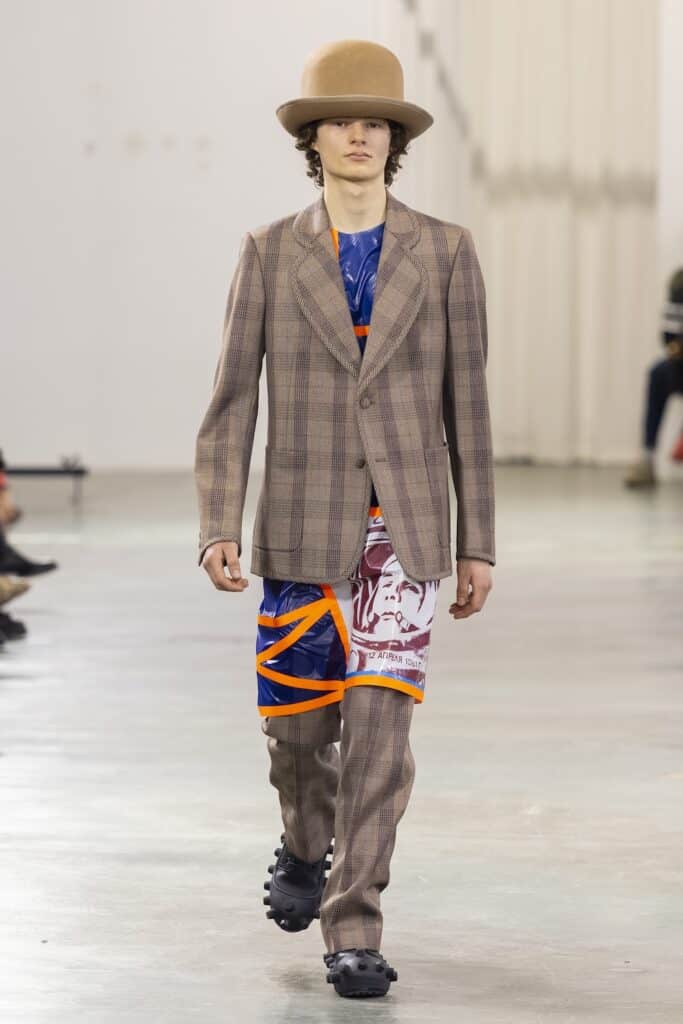
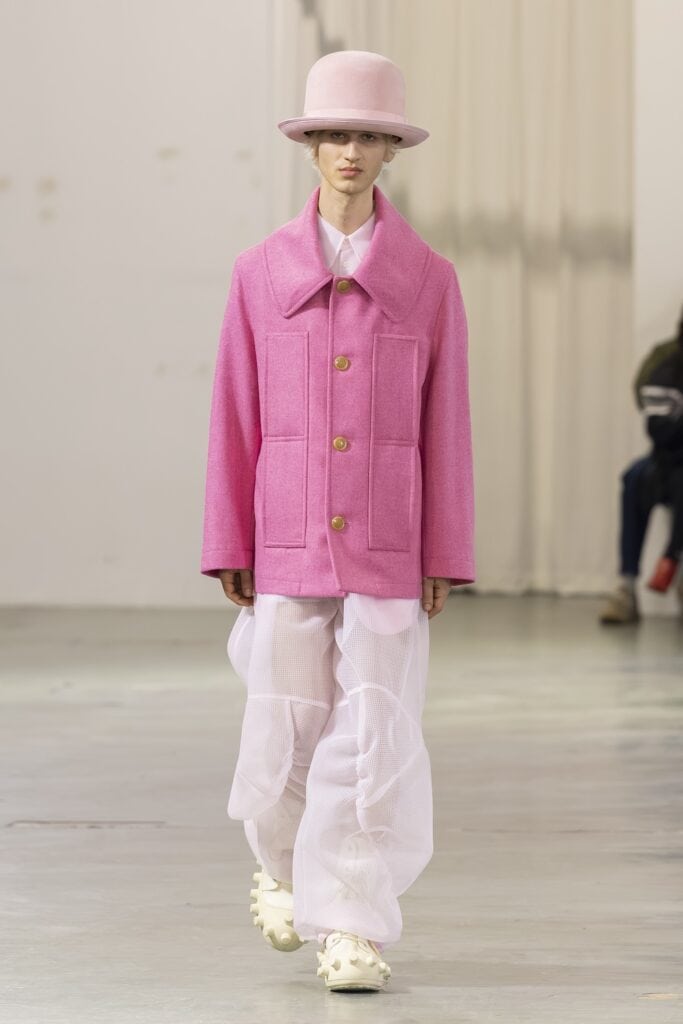
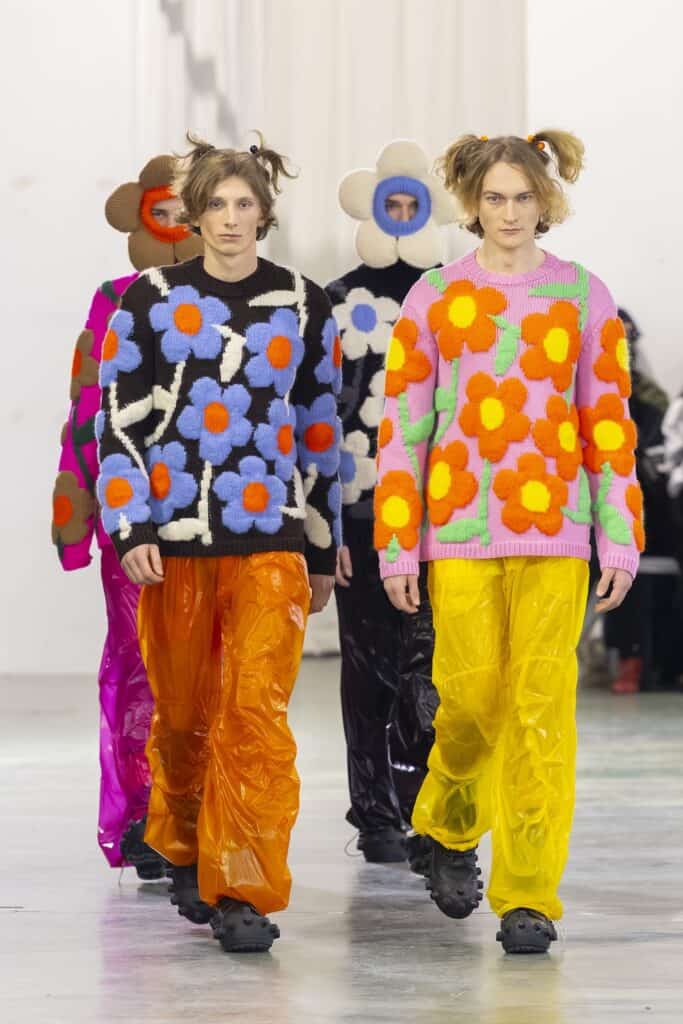
Not only aggression but also tenderness shapes the collection. He pairs plastic artillery with flowers. He introduces 3D birds, guns, and blooms that detach, rearrange, and recombine. In other words, the expressive contradictions found in Walter Van Beirendonck’s work become a constructive force.
At the same time, war carpets inspire knitted patterns that carry memory and history. For this reason, tape appears as both material and marker, binding Walter Van Beirendonck’s stories into form.
Covers, Bodies, and Utility
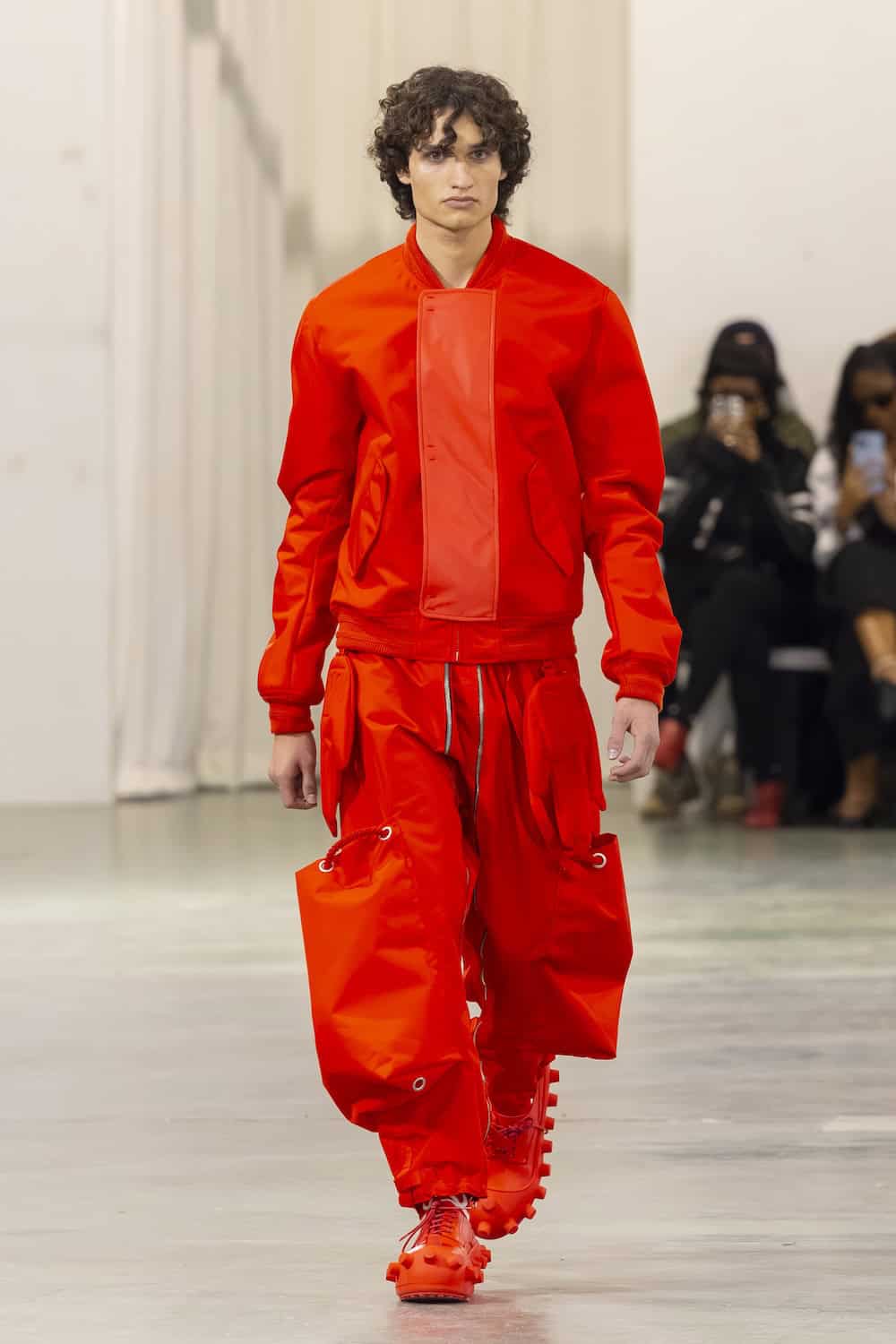
Meanwhile, the collection explores the idea of covers. Protective sheets placed over artworks and furniture suggest preservation. In this, the collection covers become garments, allowing bodies to move beneath them.
Utilitarian smocks outline silhouettes built around EASTPAK backpacks. Fine tailoring confronts technical fabrics. British wools meet nylon and plastic. By comparison with earlier seasons, the palette remains restrained. Ton sur ton replaces clash. Nevertheless, modularity restores freedom. Sleeves detach. Belts reshape volume. T-shirts anchor the looks and, in this way, echo the practical side of Walter Van Beirendonck’s approach.
Youth, Language, and the Scarecrow
At this point, language enters directly. Some shirts ask: HI THERE, ARE YOU FR? This question does not soften its intent. Rather, it confronts dismissal head-on, a recurring theme in Walter Van Beirendonck narratives.
There is a tendency to underestimate new generations. However, the designer insists otherwise. Youth represents truth, even when the world denies it. Puk Puk returns as a signal. Still present. Still moving, as is often emphasized by Walter Van Beirendonck in his discussions of youth and rebellion.
Naming the Scarecrows
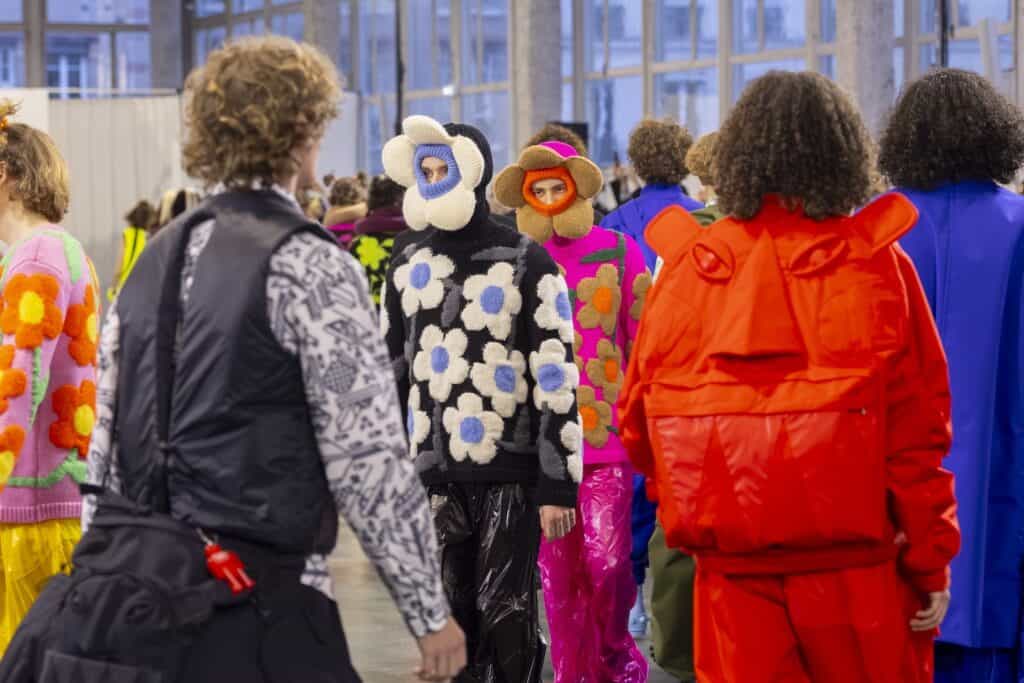
Youth become the Scarecrows of 2026. They receive names now, before they vanish unnamed, and, as this collection shows, the imagination of Walter Van Beirendonck leaves a lasting mark on the world of fashion.
Share this post
One day when I was barely two my mom let me push her out of her bedroom. She was curious so she ran outside the house so she could watch me through the window. I climbed up on a chair by her vanity and started putting on her makeup. I loved playing dress up as a kid. Putting on my mom's sequin tube tops and high heeled shoes and then putting on a dance show in the lobby or the restaurant of the hotel/residence we lived in. It was the best childhood ever. Dress-up, dancing, playing with barbies, and drawing were my favorite things to do. I have not changed one bit today. If I am creating I am happy.
Now I am in Paris for the second time in my life and I am having a ball playing with my partner in crime Julien Crouigneau. We founded IRK Magazine together in 2015 and we are proud to collaborate with some amazing artists, and influencers.
We are also a photography duo under the pseudonym French Cowboy. We love to tell stories and create poetic images that are impactful.
Read Next