

PANDEMONIA: PLASTIC FANTASTIC
Patrick Duffy
The Architectural Marvel of an Inflatable Icon, Pandemonia
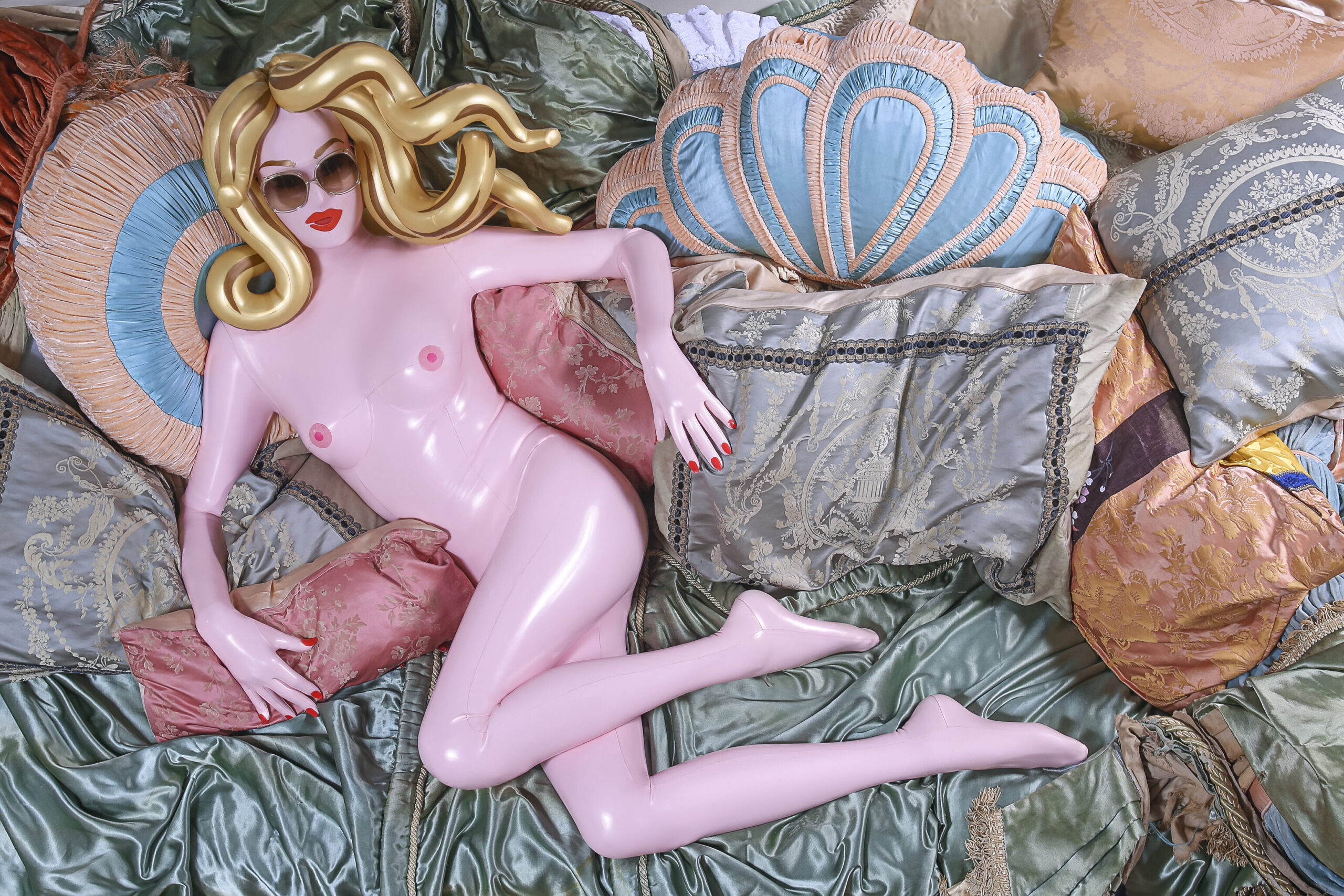
I first met Pandemonia at the V&A during Richard Quinn’s Fashion in Motion show, which is perhaps the only sensible place to meet a seven foot inflatable blonde. The museum was already alive with Quinn’s delicious theatre: extravagant silhouettes, floral fantasies and enough fashion drama to make a Tudor monarch look underdressed. Then Pandemonia appeared.
She did not simply enter the room. She changed its dimensions.
Heads turned, cameras rose and the crowd rearranged itself around her as if obeying a glamorous new law of physics. In a museum filled with priceless objects, Pandemonia had become the main exhibit, and unlike several of the antiquities, she knew exactly where her best light was.
04/06/2020
The Wit and Wisdom Behind Pandemonia’s Silhouette
When I later sat down with her for this interview, I discovered that behind the monumental silhouette and immaculate vinyl surface is someone incredibly kind, curious, camp and devastatingly witty. Pandemonia considers each question with the intelligence of an artist and delivers every answer with the timing of a seasoned cabaret star. The illusion may be inflated, but the wit is razor sharp. Within minutes, we were discussing Marx, Duchamp, Warhol, British class, Anna Wintour and the cultural possibilities of airborne blancmange. It was less an interview than a masterclass in turning serious ideas into very glamorous trouble.
Pandemonia, it should be noted, was not born. After all, birth is messy, unpredictable and notoriously unbranded. “Born? Darling, I was poured,” she declares. Somewhere along the way, she explains, there is a mould, a fan heater and “a very patient person with talc up to the elbow.” There are no childhood photographs, unfortunate school portraits or small town escape narratives waiting to be optioned by Netflix. Pandemonia arrived fully formed: blonde, monumental and shinier than most people’s careers.

04/06/2020
Manufactured Fabulosity: How Pandemonia Was Built
“Nobody is born fabulous,” she says. “Fabulous is manufactured. I was drawn, then built, then inflated, a girl assembled from advertising, plastic and wishful thinking.” For more than two decades, the British pop artist has occupied the champagne soaked territory between fashion, performance, celebrity and social criticism. As a result, at seven feet tall, much of it air, she appears at runway shows and gallery openings like an advertising fantasy that has escaped into the wild: part Hollywood bombshell, part philosophical provocation, part extremely glamorous weather balloon.
Beneath the high gloss surface, however, is labour: pattern cutting, gluing, construction and the sort of backstage drudgery glamour spends a fortune pretending never happened. Consequently, “Marx spotted it first,” she says. “Every glamorous object arrives pretending it was never made.” A tin of soup is tomatoes, metal and someone working the night shift, yet on the supermarket shelf it appears radiant and seemingly untouched by human hands. “Warhol just had the good manners to hang it on a wall.”

04/06/2020
Duchamp’s Ready Made Blonde
Pandemonia considers herself a ready made in the tradition of Duchamp, although naturally she selected something with better hair. “Duchamp fell for a urinal; I went for the blonde. Same gesture, better silhouette.” The blonde bombshell was already waiting in mass culture: tall, glossy, female and endlessly reproducible. Pandemonia found her, signed her and walked her down Bond Street. “Then I got in it.” Accordingly, her recipe is ‘three parts Marx, two parts Duchamp, finished in a Warhol gloss.’ It is practically intellectual meal prep.
Imagine Pandemonia entering Annabel’s at its decadent peak. Bowie is fascinating. Grace Jones is terrifying the furniture. Bianca Jagger has either arrived on a horse or left in a mood. And there is Andy Warhol, stationed against the wall with a Polaroid around his neck, a model called, inevitably, the Big Shot.

04/06/2020
Pursuit of the Big Shot
“I’ve only ever had eyes for the Big Shot,” Pandemonia says. At first, one assumes she means the usual variety: rich, powerful and beautifully connected. “Everyone assumes I’m after the money. I’m not. I’m after the lens.”
The Big Shot was Warhol’s portrait camera, used to photograph the wealthy society figures who commissioned his work. It was also, rather deliciously, his favourite model. The pun is pure Pandemonia: the glamorous blonde pursuing the Big Shot, only to reveal that the object of her desire is not the man with the wallet, but the camera that makes him immortal.
“I’ve never been so jealous of a piece of plastic,” she says. “And I am a piece of plastic.”
Money, after all, is temporary. “The money runs out. The man moves on. The image doesn’t. Everything else is overheads.” Bowie she would talk to. Grace she would be seen with. Bianca, inevitably, “would have left in a mood.” But Pandemonia only has eyes for the Big Shot. She is not a gold digger. Rather, she is ultimately hunting immortality, and consequently knows perfectly well who in the room is carrying it.

04/06/2020
British Rebellion According to Pandemonia
Fittingly, Pandemonia’s rebellion is unmistakably British. The country has produced Westwood, McQueen and Galliano, along with generations of creative misfits who looked at the rules and decided they needed safety pins. Why does Britain do rebellion so well? “Class, weather and irony.” Britain provides a rigid social system and enough rain to sit indoors plotting its destruction. “Less rain lately,” she notes. “The system’s holding up fine.”
Rebellion needs something to rebel against, ideally backed by a strong costume department. To that end, Britain offers uniforms, corsets, royal ceremonies, Savile Row tailoring and centuries of inherited nonsense waiting to be cut up and worn incorrectly. “Westwood didn’t invent the corset; she put it on the outside. McQueen didn’t invent Savile Row; he weaponised it.” The British establishment also continues to provide artists with its most renewable natural resource: people saying no. “This country is still stuffed with people whose entire job is telling you no. Marvellous for us. A rebel is only as good as the person refusing her entry.”
Pandemonia was serving artificial perfection long before Instagram gave everyone cheekbones apparently designed by the same committee. She created an exaggerated, highly manufactured public persona before filters, influencers and the suspiciously spontaneous photo dump. Does she feel she accidentally became the blueprint for contemporary culture?
“Yes.”
That is her entire answer. It is also the correct one.
04/06/2020
Costumes All the Way Down
After all, Pandemonia believes everyone is performing. The primary difference is that she noticed twenty years ago and built her performance out of latex. Indeed, ‘There’s no authentic self underneath, darling. Costumes all the way down.’ Thus, every morning, the rest of us put on ‘person going to work,’ ‘person casually drinking coffee’ or ‘person definitely not checking who viewed my story.’ At its core, it is the same performance, only with a smaller budget and considerably worse lighting.
Most people hide the seams. Pandemonia displays hers. “One asks you to believe it; the other asks you to look.” Authenticity, she argues, may be the most elaborate performance of all: hours of work devoted to appearing untouched, unbothered and accidentally luminous. Indeed, a celebrity’s no makeup portrait can require enough professionals to populate a regional theatre company.“Exhausting,” she says. “I’d rather be obvious.”
Indeed, after attending more fashion weeks than most editors, and possibly several chairs, Pandemonia is unequivocal about which is more entertaining: the runway or the front row.“The front row. Obviously. Nobody’s ever been photographed looking at a dress.” The runway is the advertisement; the front row is the product. Clothes appear for eleven minutes, but the seating chart provides weeks of intrigue. Who sits beside whom? Late arrivals strategically time their entrance to be seen. Meanwhile, guests pretend not to notice the photographer standing six inches away while cameras snap.

The Spectacle and Pandemonia’s Dream Cast
Pandemonia adores the spectacle and makes no claim to moral superiority. “I’m not above it. I’m the whole seven feet of it and most of that is air!” Fashion, she understands, is never simply about clothes. It is about proximity, performance, aspiration and ensuring that, when the cameras turn, one’s face suggests complete surprise at an entirely predictable event.
Her fantasy dinner party would be less an intimate gathering than a three act theatrical ambush. She has no guests, only a cast. Alfred Jarry is “The Director.” Niki de Saint Phalle, who shot paintings until they bled colour, is “The Accomplice.” Jeff Koons is “The Target.” “A man of immaculate finish,” Pandemonia says. “I’d like to see what custard does to it. Practically a commission.”
“The Philistine” is whichever government minister most recently cut the arts budget but remains eager to be photographed beside an artist. “The Ice Queen” is Anna Wintour, sunglasses firmly in place as blancmange slides gently off the bob. Nobody is refused entry. The critic who calls Pandemonia’s work whimsical may come. So may the man who wants to know what is underneath and whoever turned authenticity into a marketing strategy.

04/06/2020
The Ultimate Act
Act One begins with champagne. Everyone is charming and nobody suspects a thing. Then, Act Two brings the creeping realisation that the guests are not merely attending the performance. In fact, they are the performance. Finally, Act Three is Bugsy Malone by way of contemporary art: custard at head height, Niki reloading, Koons avoiding the camera for the first time in his life and the minister forced to wear his own arts policy. “Total pandemonium,” she says. “Everyone glazed. Fortunately, some of us are wipe clean.”
In Pandemonia’s utopia, everyone would wear their construction openly. We could stop searching for the real person behind the image and simply enjoy the image. Then comes hyperinflation: more clubs, bars, zebra crossings, escalators and multi storey car parks. More mustard, pickle and relish, alongside an abundance of champagne, culture, and laughter plus, simply more bounce.
Sitting with Pandemonia brought back memories of our first encounter at the V&A. What stayed with me was not simply her scale, the latex or the magnificently immovable hair. Her mere presence instantly exposed everyone else’s performance. Editors became editors, photographers became photographers and guests became an audience within seconds of her arrival. Pandemonia does not enter a room to escape reality. She enters to expose its thorough staging.

Twenty Years of Pandemonia
The glamour is the delivery system. You come for the spectacle and leave carrying Marx, Duchamp and an uncomfortable question about your own performance. A Trojan horse, darling, in better heels.
She does not promise authenticity. Instead, she offers something far more useful: excellent production values, an immaculate silhouette and absolutely no shame about the seams. “We could have been anything that we wanted to be,” she says. “And darling, I was.”
Before we part, she leaves one final, tantalising detail. “Oh, and darling, there’s a retrospective coming, and you MUST come. Twenty years of work: costumes, paintings, sculpture, prints, films and animations. They are currently finalising the location.”
Twenty years of Pandemonia, all under one roof. One hopes the ceilings are high enough.
Credits:
Photography by Martin Pope
Art Direction by Sera of London
Costume & Post Production by Pandemonia

Share this post
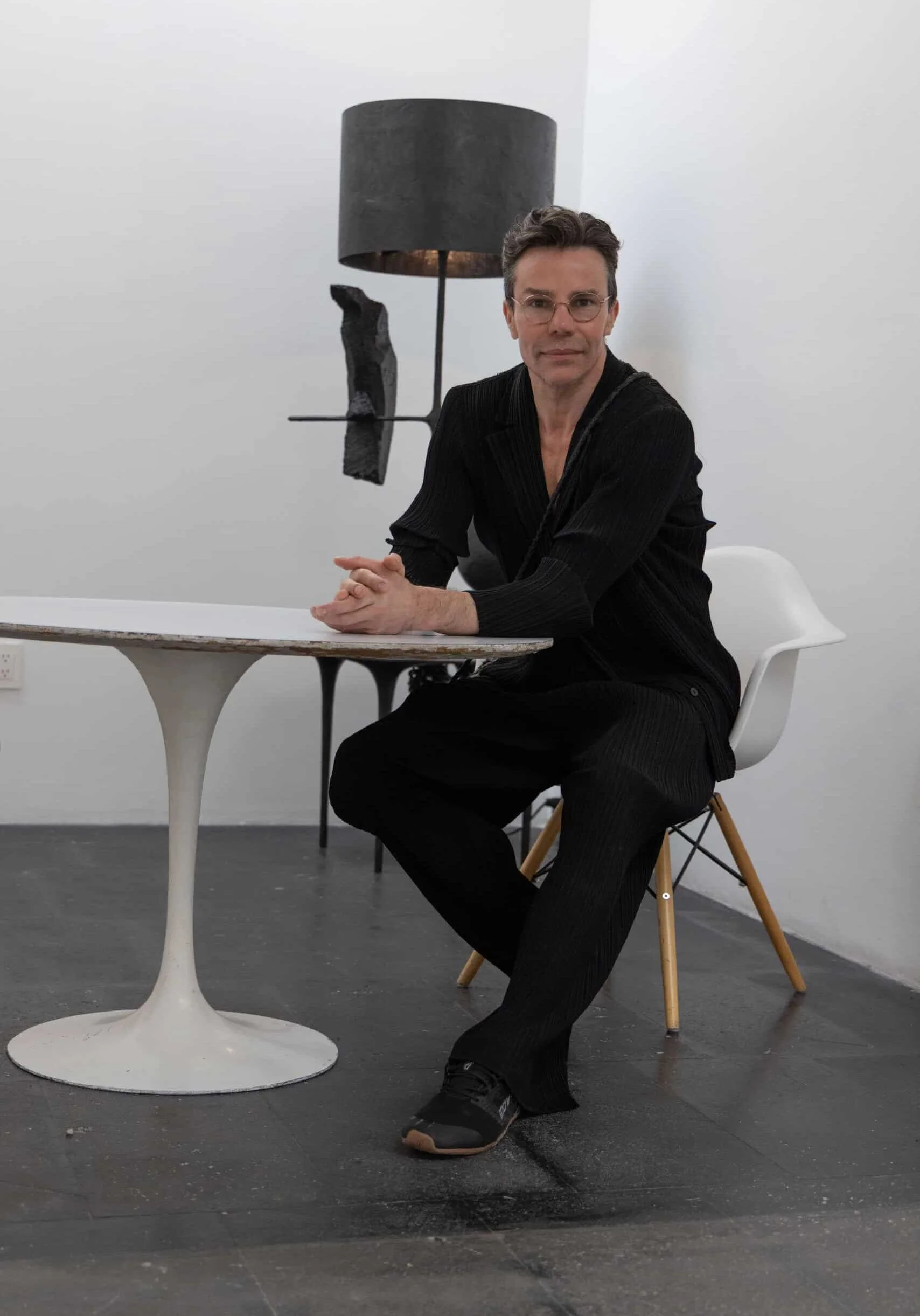
Patrick Duffy is the founder of Global Fashion Exchange, a company catalyzing positive impact through strategic consulting roadmaps focusing on supply chain transparency, worker rights, responsible production for B2B as well as consumer facing programming and community building focusing on aligning people or communities with the SDGs.
Experience developing networks and activating ideas, guiding creative teams globally, and working with institutions like the Victoria and Albert Museum and UNESCO, and iconic spaces such as Federation Square Melbourne, Madison Square Garden, Bryant Park in New York City, and The Dolby Theatre in Los Angeles.
Patrick has produced clothing swaps all over the world from, with GFX Active in over 100 countries. Each GFX event focuses on building community, education and transformational business models. Partnering with global brands, key stakeholders, and academia to help create awareness and positive impact through conscious consumption
Patrick harnesses the power of media to create positive social and environmental impact. Through storytelling, education, and advocacy, he raises awareness, inspires action, to catalyze change. By highlighting issues and solutions, Patrick creates strategic campaigns to engage audiences, influence attitudes and behaviors, and contribute to a more sustainable and just world. Additionally, Patrick is the Sustainability and Positive Impact Director of Paris based @IRKMagazine and Editor In Chief of @IRKLiving
Patrick has produced and co-curated events and marketing/PR campaigns for recognized brands across art, fashion, and tech spaces including @virginhotels @britishfashioncouncil @mspdid @moethennessy @microsoft @lagosfashionweekofficial @perutradenyc @fashionimpactfund @istitutomarangonidubai @peaceboatus @lisboafashionweek and more spanning 15 years and hundreds of events in 5 continents.
Read Next


