

Ethem Onur Bilgiç: The Anatomy of a Line
Gülsüm Tuğlu
Bridging heritage and international platforms, Ethem Onur Bilgiç discusses craft, motion, and imperfection.
In an era of sterile digital perfection, Ethem Onur Bilgiç transforms the graphic line into an emotive narrative. During his university years in Istanbul, he discovered Ralph Steadman and Ashley Wood. This discovery shaped his multidisciplinary practice across cinema, literature, and editorial art. Consequently, his diverse portfolio spans award-winning animated shorts like Salkım Söğüt. He also reimagines Turkish literary classics by Sabahattin Ali and Ahmet Hamdi Tanpınar.
Furthermore, Bilgiç seamlessly brings local textures to global audiences through landmark projects for DC Comics and features in TASCHEN’s prestigious anthologies. Rather than relying solely on clean digital vectors, he actively archives real ink stains and paper textures to preserve the organic traces of the human hand. In this conversation with IRK, Bilgiç discusses visual problem-solving, the resonance of authentic cultural storytelling, and the future works that continuously drive his practice forward.

Early Inspirations of Ethem Onur Bilgiç
IRK: How did early inspirations like Ralph Steadman and Ashley Wood forge your distinct visual language?
Ethem Onur Bilgiç: I first encountered the work of Ralph Steadman and Ashley Wood after entering university. Until I started at the academy, I had a fairly conventional approach to drawing. As I discovered these artists, I realized that line was not merely a tool for defining form; it could possess character, emotion, and narrative power in its own right. That led me to start exploring different visual vocabularies.
The seminar Steadman gave at our university also made a profound impression on me. I spent long hours in the university library, discovering new possibilities with every artist and visual language I came across. Everything I learned reshaped me a little more, pushing me to reconsider my linework.
Looking back, I believe what remains most vital from that period is that drive to explore. Rather than repeating a specific style, I continue to push the boundaries of line and investigate different expressive possibilities.
IRK: From static illustration to animation like Salkım Söğüt, how does narrative shift when introducing time and movement?
Ethem Onur Bilgiç: One of the most significant dimensions motion adds is the inclusion of sound. Illustration and animation might seem like distinct mediums at first glance, but to me, they are built on the same narrative foundations. Composition, rhythm, atmosphere, and the emotion you wish to leave with the audience are decisive in both.
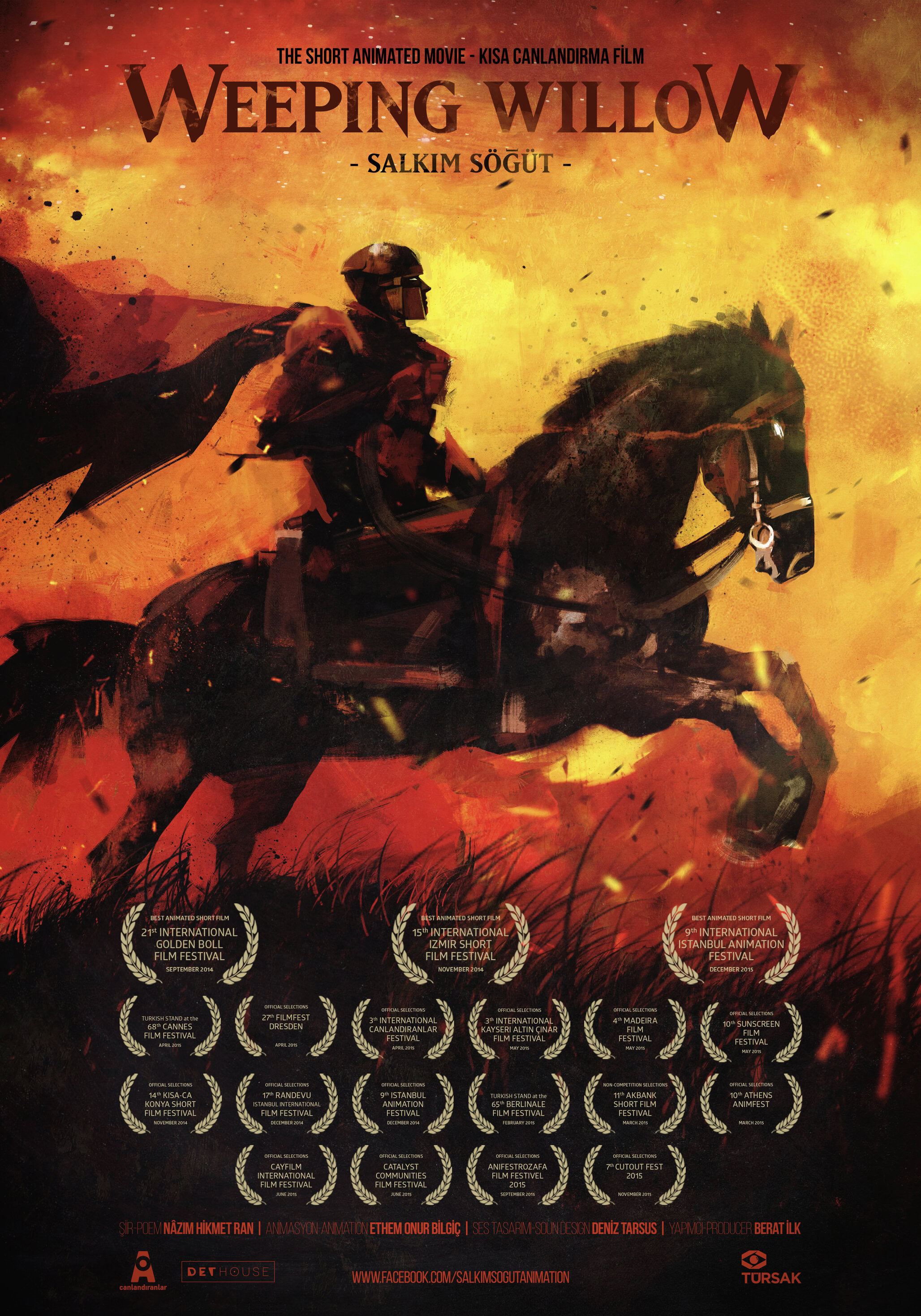
Salkım Söğüt grew out of that perspective. Initially, we were discussing what illustrations of the poem might look like. I felt we could convey the poem’s emotional resonance far more intensely through motion, time, and sound. I wanted to experiment with that, and the process ultimately yielded an animated short.
In a single frame, the viewer’s imagination constructs time; in animation, you dictate that rhythm yourself. Designing how long an image lingers, where an action begins and ends, and which emotion the sound amplifies brings an entirely new dimension to the narrative.
© Ethem Onur Bilgiç
Ethem Onur Bilgiç: From Literary Classics to DC Comics
IRK: Reinterpreting masters like Tanpınar and İhap Hulusi, how do you modernize classic literary narratives while preserving their essence?
Ethem Onur Bilgiç: Gökhan Yücel was the first to mention the Time Regulation Institute project to me. While
reading the book, he wondered what promotional posters for the institute in the novel might look like. I immediately brought up İhap Hulusi Görey, and the idea excited me so much that I got to work right away.
I wanted the posters to embody the spirit of that era. Rather than directly imitating elements of İhap Hulusi’s visual style, I sought to reinterpret them through my own linework. It turned into a great series. The pieces circulated widely on social media and numerous blogs. Eventually, Turkish high school textbooks even included them in their graphic design curriculum.
For me, the goal is never to present a classic work as something frozen in the past. While preserving the historical essence of the text, I aim to build a visual connection that resonates with contemporary readers.

© Ethem Onur Bilgiç
IRK: From indie novels to giants like Nike and DC Comics, how do you protect your tactile signature?
Ethem Onur Bilgiç: In commercial advertising projects, I make a point of respecting the agency’s and the
brand’s expectations. At the same time, I always look for ways to leave an authentic personal touch. Even when major brands seek you out specifically for your name or visual identity, there are usually defined parameters around the brief.
As a designer, I welcome those constraints. I enjoy figuring out how to stretch them, broaden them, or push past them when necessary. Sometimes the room is there, sometimes it isn’t; either way, working within friction feeds the creative process.
Compared to agency driven brand work, comics and editorial projects have generally offered more creative freedom. Regardless of the medium, I constantly search for spaces where my authentic visual voice can emerge.
IRK: Being recognized globally, such as being featured in The Illustrator: 100 Best from Around the World and winning awards at prestigious film festivals what does it mean for you to carry a piece of local narrative onto an international stage?
Ethem Onur Bilgiç: It is an immense honor. Being featured alongside 99 illustrators from across the globe in The Illustrator: 100 Best from Around the World was truly special, and I am grateful to the editors and to TASCHEN.
Our DC projects hold similar significance for me. These include Batman written by Ertan Ergil, Joker by Metin Akdülger, and Superman, which I wrote myself. As part of The World series, we brought stories set in Turkey into comics distributed worldwide. We wove local settings, characters, and cultural motifs into those narratives.
Carrying local texture into international platforms matters to me. I don’t believe a work needs to be stripped of its cultural roots to become universal. On the contrary, sincere and authentic local storytelling often resonates much more deeply across the world.

© Ethem Onur Bilgiç
Ethem Onur Bilgiç on the Analog Grit & Ink
IRK: Across your diverse body of work, what underlying visual motifs do you find yourself constantly revisiting?
Ethem Onur Bilgiç: I don’t constantly repeat specific symbols. Instead, I strive to maintain a consistent visual sensibility and perspective. Naturally, differences emerge across mediums. An interior book illustration demands something quite different from an advertising poster.
Still, I approach every project with similar core questions: What is the primary emotion here? Which details need to surface, and which should recede? How should the image engage with the viewer? My rough sketches almost always develop around these inquiries.
So while there may not always be overt visual motifs linking the works, there is a shared way of thinking and problem-solving. I see my artistic signature not just in how the line looks, but in how I approach a problem.

© Ethem Onur Bilgiç
IRK: Despite working extensively with digital tools, your pieces always retain a raw, hand-crafted, ink and paper texture. How do you protect the organic imperfections of traditional art in an increasingly digital era?
Ethem Onur Bilgiç: Even when producing drawings digitally, I create the textures, stains, and ink splatters on physical paper first and archive them. I then incorporate these elements into my digital workflow. I want to disrupt the overly clean, sterile feel that digital production can sometimes have; those marks are a fundamental part of my visual identity.
In truth, I can be quite messy when working on paper. My hand or arm will inevitably brush against something, ink will splatter where I hadn’t planned, or an unexpected smudge will appear. I don’t view these accidents as errors to be erased. More often than not, they give the work vitality and character.
Whether I work with traditional or digital mediums, those imperfections and uncontrolled marks feel like a truer reflection of who I am. Rather than perfection, I look for a surface that bears the unmistakable trace of the human hand.
Ethem Onur Bilgiç: Design Mindset & the Unfinished Canvas
IRK: From graphic novels to cinema, how do you determine the visual language a narrative truly demands?
Ethem Onur Bilgiç: My background is in graphic design. Whenever a project comes across my desk or I want
to tell a story of my own, I first establish a dedicated toolkit and methodology for that specific piece. From there, I explore how best to resolve the core idea.
I treat every challenge as a design problem. I focus entirely on what the narrative truly demands. Instead of choosing a medium beforehand, I let the story dictate its vehicle. A single still frame might suffice. Other times, the concept calls for motion, sound, or an evolving durational arc.
Because of this mindset, designing a poster, illustrating a book cover, or writing a screenplay don’t feel like fundamentally separate pursuits. At their core, they are all an effort to communicate an idea as precisely, clearly, and powerfully as possible.
IRK: You collaborate across diverse publishing and cultural spheres. What defines an ideal creative partnership for you? How do you draw energy from the texts or brands you join?
Ethem Onur Bilgiç: Commercial brand and agency projects naturally come with parameters rather than
limitless freedom. But communication is at the core of what we do. Through dialogue, listening closely, and articulating the reasoning behind our ideas, we can arrive at a shared vision that both sides genuinely believe in.
Cultural projects tend to offer more room for creative exploration. For instance, I might design a poster for a theater production or a film without featuring a single actor’s face. I naturally gravitate toward projects where the visual isn’t merely promotional, but acts as an autonomous interpretive space for the work itself.
That said, commercial work is an integral part of my practice. Operating within different constraints keeps my visual problem-solving sharp. For me, an ideal collaboration is one where both parties give each other room, where ideas can be debated openly, and where the final piece is the product of shared conviction rather than a one-sided mandate.

IRK: Looking back across your creative journey, which unaddressed aspect of your practice deserves more light? What question would you ask yourself?
Ethem Onur Bilgiç: “What is the work you haven’t made yet, but that everything you’ve created so far has
been quietly preparing you for?”
I would choose this question because I don’t see my past work merely as finished pieces. Each one might be a stepping stone or an experiment toward something I haven’t yet put a name to. I don’t fully know what that work is today. Perhaps what keeps a creative practice alive is the very fact that this question doesn’t yet have a definitive answer.
Share this post

I approach editorial storytelling from a dual perspective: a foundation in industrial engineering paired with a deep immersion in visual culture and fashion journalism. This background allows me to dissect creative narratives with both analytical clarity and intuitive curiosity.
My work explores the intersections of contemporary art, innovative craft, and design. Through in depth artist features, material explorations, and cultural critique, I focus on capturing the subtle friction between technical mastery and unrestricted aesthetic expression.
Read Next


