

HUNCH, the Model Agency for Women Aged 40+
Nia Sayer
HUNCH represents women aged 40-70, hoping to make the fashion and beauty industries more age inclusive. But if the average age of its booked models is just 44, how accepted are older women in the public eye, really?
While the fashion and beauty industries are making small steps towards age diversity, if women in their early-forties still constitute the ‘safe-zone’ for representing older women, ultimately this supposed progress incurs its own boundaries. In this exclusive interview with Anabel Luna, founder of HUNCH, we look beyond the age of the model in the final image, and uncover what determines how she gets there.
HUNCH Models
Anabel Luna founded HUNCH in 2025, the first talent agency in Spain dedicated to representing female models aged 40+, across fashion, beauty, jewellery and lifestyle.
After more than two decades working as a photographer and creative director, Luna kept seeing the same issue. Brands increasingly wanted to speak to a more mature female consumer, but casting choices remained limited. If and when older models were used, they were typecast as feminine stereotypes: reduced to the roles of mothers and grandmothers.
So, Luna created HUNCH, hoping to give older women back their identities and carve a space for them to exist as the protagonists of fashion and beauty imagery, independent of their age:
‘I wanted to build an agency where age itself wasn’t the character. Models don’t need to represent motherhood or ageing. They can simply represent themselves.’
The ‘Safe Zone’ for female ageing
HUNCH primarily represents women aged 40 and above:
40-44: 8 models
45-49: 9 models
50-54: 14 models
55-59: 12 models
60-69: 11 models
70+: 2 models
That’s what makes the average age of 44 for HUNCH’s booked models particularly shocking. There’s no shortage of mature models available; the shortfall lies in the industry’s willingness to cast them. This reluctance stems from what brands think their consumer wants to see: apparently women who show zero signs of visible ageing.

Age for Optics
It’s not that models over 44 never appear. Luna tells me:
‘We have had bookings in the 50s and 60s, and opportunities involving models into their 70s’.
The problem is:
‘The further you move away from that safe zone, the more specific the brief tends to become.’
Older women do get booked, but often solely because they’re older. Their age risks becoming the defining characteristic of the image, reducing a multidimensional woman to a single demographic category.
I ask Luna how HUNCH models feel about being chosen to improve optics:
‘They tell us visibility is important, but that they don’t want to be booked simply as a gesture towards diversity. They want to compete for genuinely interesting fashion and beauty work.’
Luna explains:
‘That distinction is important. There is a difference between genuinely normalising models of different ages across fashion and beauty, and occasionally booking someone older because a campaign specifically requires an older character.’
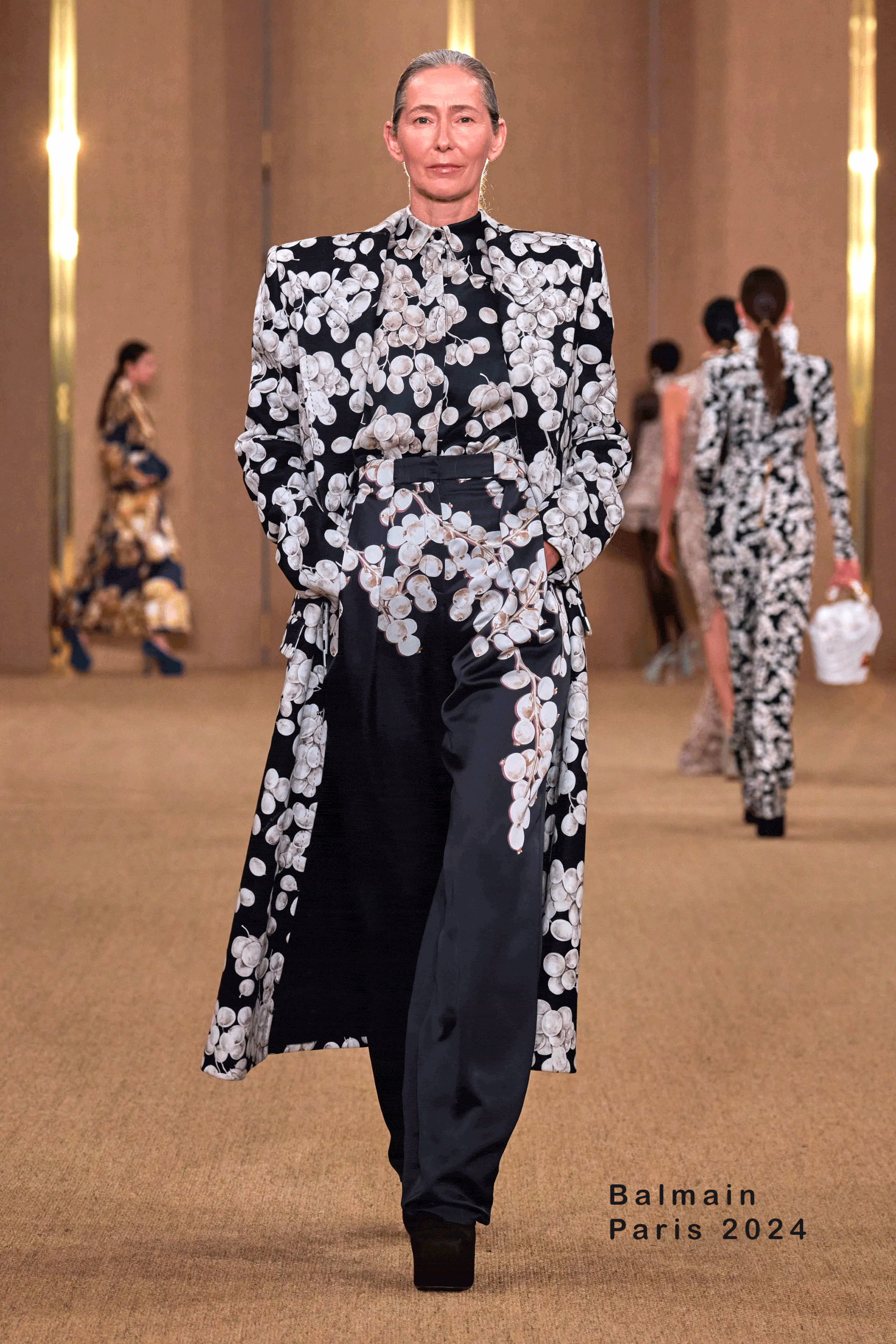
It shouldn’t be so rare to see an older woman that it becomes the entire point of a campaign. Real progress will be when we see layered, 40+ characters whose least interesting trait is their age.
HUNCH Lab
HUNCH Lab is the research arm of the agency, dedicated to understanding the processes behind choosing an older model. By identifying the factors and trends that determine a casting decision, HUNCH hopes to redirect ageism towards age inclusivity:
‘We started recording outcomes, client feedback, budgets, usage, age requests, creative direction and final bookings because I wanted to understand the gap between intention and reality. The ambition is to use our position inside the industry to identify patterns, make them visible and eventually give brands, casting directors and creative teams better information with which to make decisions.’
This is what they found
Using a dataset of 100 castings, HUNCH Lab investigated what influences the age of the model chosen for a campaign:
‘There is an entire decision-making process underneath the final image, almost like an iceberg. HUNCH Lab is interested in everything below the surface.’

Firstly, budget matters. An older, more established model might be perfect for the campaign, but the budget simply won’t stretch to include her:
‘The model who fits the creative direction may not fit the budget, and that can completely change the outcome.’
Then, of course, creative direction is a key factor:
‘The way a brand imagines the woman before they even start casting can already define a fairly narrow age range, even when the brief sounds much broader.’
They may say they want an older woman, but their idea of how ‘old’, ‘older’ looks might be small.
Luna tells me this discrepancy is something her models frequently discuss. Their shared sentiment is that ‘the industry talks increasingly about “real women” while continuing to have quite narrow ideas about which kinds of real women are desirable.’
Another factor influencing the age of the model chosen is client feedback:
‘Client feedback is another fascinating part of the process. A brief might initially ask for women aged 40-60, for example, but when actual faces are shown, the final selection can gradually move younger.’
Unfortunately, there are often false promises between the conceptual discussion of an ‘older’ model, and actually committing this older face to a campaign.
Beauty promises progress
HUNCH Lab finds that beauty campaigns use older models than fashion, because age adds credibility to the advert. Luna notes that skincare deserves credit here, often showcasing lived-in skin and authentic textures. Beauty brands understand consumers are more likely to connect to an image that feels relatable and convincing. Women want to see themselves represented in the product they’re buying. For example:
‘A 55-year-old woman buying skincare often wants to understand what that product looks like on skin that bears some relationship to her own.’

Fashion is more old-fashioned
Unlike beauty, fashion campaigns rarely showcase older models. As Luna explains, style is often associated with younger rather than older generations:
‘Fashion still has a much deeper historical attachment to youth as an aspirational code.’
Indeed, there seems to be an unspoken expectation that, as women grow older, they must trade personal style for conservative dressing. Short skirts become unconventional, while long hair is often exchanged for a more subdued bob. As they age, women are encouraged to become more modest, less obvious. In a sense, more invisible.
Consequently the fashion industry remains reluctant to advertise older women in campaigns, responding to a wider cultural tendency to overlook them as modern and stylish.
This forms a vicious cycle: the industry rarely casts older women, because it assumes that’s not what consumers aspire to. And so, by excluding them from fashion imagery, the industry reinforces the very label that older women are less fashionable and desirable.
As Luna explains, these ingrained stereotypes aren’t ‘necessarily what the consumer thinks’.
Altering how society views older women, however, will require the industry to move beyond token age representation:
‘The visual language of fashion has been built around youth for decades, so changing it requires more than simply adding an older model occasionally.’
Reframing the Picture
In order to dismantle prejudices surrounding older women, we must start by reframing how these women are advertised to the world. Perhaps the most powerful discovery to come out of HUNCH’s research is this: despite what the industry suggests about ageing, the models themselves don’t feel any less beautiful as they grow older. In fact, they consistently express, with their growing age comes a growing sense of self-confidence:
‘They question why their visibility within fashion should diminish precisely at a point when they themselves often feel more confident in who they are.’
It is this sense of female empowerment that campaigns should place at their heart. The real women behind the models, experienced and comfortable in their own skin, should inspire the female characters we see in advertising. Her age should of course, be visible, but there is so much more to her story than that.

Share this post

With a joint-honours degree in English and French, my writing is driven by a fascination with the ways culture shapes what we create, how we see, and ultimately, how we live.
I am interested in the intersections between design, fashion, travel and culture, because none exist in isolation. And so, I explore each discipline in its individuality, while also considering the ways in which they overlap, influence and enrich one another.
Through my work, I seek to uncover the connections between creativity and the stories behind it: the people, places, histories and ideas that shape what we understand as art today.
Read Next


