

ISSKA: Furniture as Fashion, Space as Story
Brendan Cannon
Reimagining the Boundaries of Architecture and Design Through ISSKA
The boundaries separating fashion, design, and art have never felt more fluid. As creative disciplines continue to overlap, a new generation of designers is challenging traditional categories, creating work that exists comfortably between worlds. Among them is Jessica Solnicki, the architect and designer behind ISSKA, a studio whose furniture collections approach design with the same sense of storytelling, silhouette, and emotion often associated with couture.
The Vision of ISSKA
Rather than treating furniture as purely functional objects, ISSKA views design as an extension of personal expression. Each piece carries a distinct presence, transforming interiors into environments that feel immersive, emotional, and deeply individual. Through sculptural forms, tactile materials, and a commitment to craftsmanship, Solnicki has developed a visual language that continues to resonate across disciplines.
At the center of ISSKA’s identity is a fascination with shape. Before material, color, or function enters the conversation, form takes the lead. Curved profiles, dramatic proportions, and sculptural silhouettes create pieces that feel almost alive within a space. Much like a fashion designer develops a recognizable signature season after season, Solnicki has cultivated a design vocabulary that remains consistent throughout ISSKA’s collections while allowing each series to maintain its own unique character.

Design Philosophy of ISSKA
Collections such as Permanent, Plage, Polo, Cosmos, and Jewel draw inspiration from a variety of sources, ranging from natural landscapes to precious gemstones and architectural forms. Despite their differing influences, each collection remains connected through a shared emphasis on movement, texture, and sculptural presence. The result is furniture that feels both contemporary and timeless, balancing artistic experimentation with everyday functionality.
Solnicki’s multidisciplinary background plays a significant role in shaping the studio’s perspective. Drawing inspiration from architecture, interiors, and fashion, she approaches furniture through a lens that values emotion as much as utility. This influence can be seen in the way ISSKA’s pieces interact with their surroundings, encouraging engagement rather than passive observation. Furniture becomes more than an object, it becomes part of an experience.
ISSKA recently brought that philosophy to life in a co-hosted event with Faena Residences Miami, presented at AP Space Gallery in New York.
Furniture as Architecture
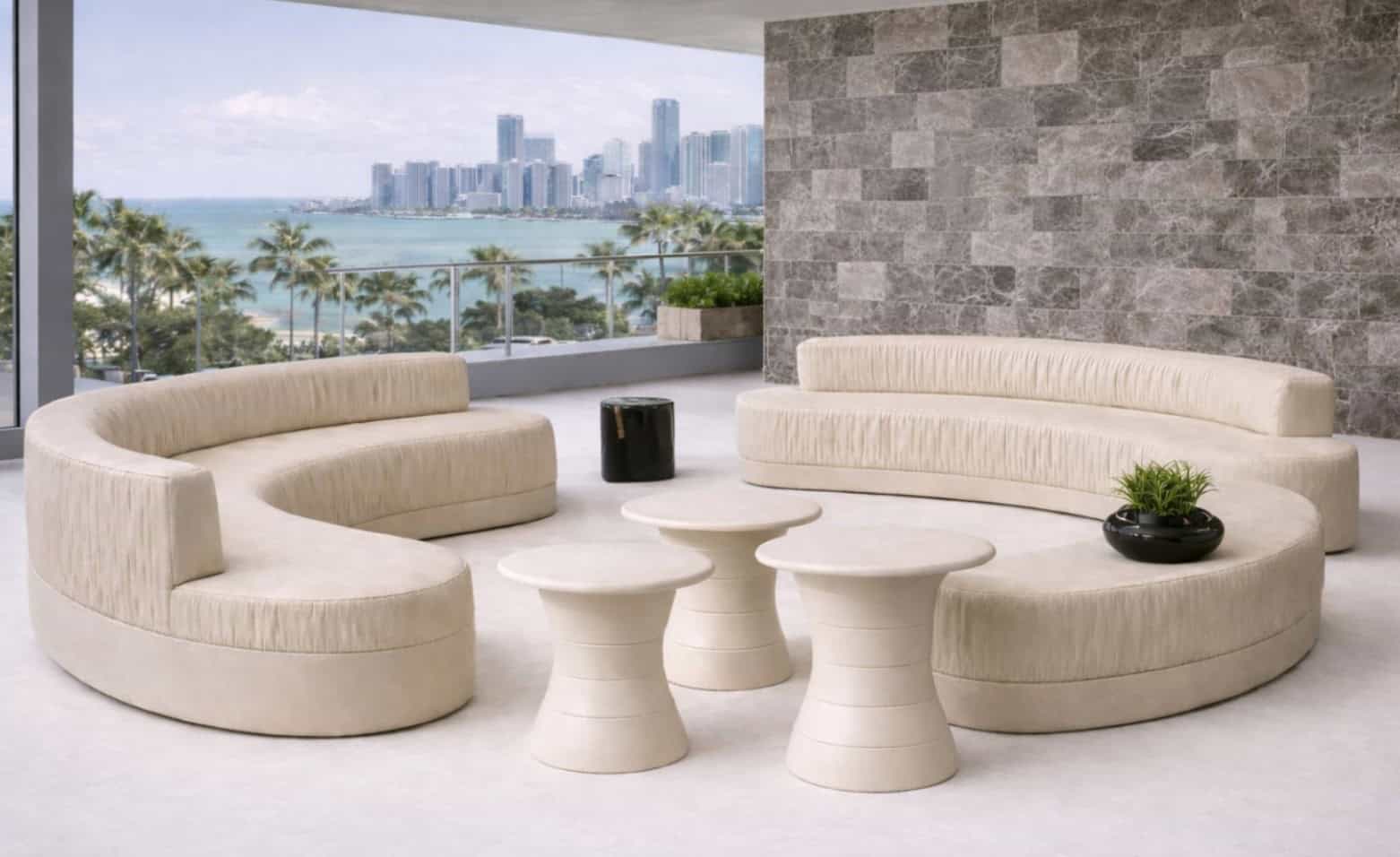
ISSKA created the interior design project for Faena Residences Miami. The studio integrated pieces from ISSKA & Things From into a cohesive world where furniture, materiality, and space merge.
The project came to life through a live performative exhibition.The project came to life through a live performative exhibition. It featured a ballet accompanied by tango music composed by ISSKA. This performance transformed the gallery into an immersive experience of movement, sound, and atmosphere. Every piece, texture, and choreographed gesture revealed a new way of inhabiting design.

The Evolution of Modern Craftsmanship
However, in a creative landscape increasingly driven by fast-moving trends, ISSKA offers an alternative perspective. The studio roots its work in craftsmanship, material integrity, and thoughtful design, emphasizing lasting impact over temporary relevance. In addition, each piece not only occupies a space, but shapes the way that people experience that space. Things From, Solnicki’s Paris-based collaboration with her partner, Geraldine Boublil, created the stools and Stucking tables. As pictured above, a pair of Stool One pieces appears alongside the Stucking tables.
As conversations around design continue to evolve, furthermore, ISSKA represents a growing movement toward multidisciplinary creativity, one where furniture can be sculptural, fashion can be architectural, and consequently, interiors can become platforms for storytelling. Through Jessica Solnicki’s vision, design becomes more than a functional necessity. It becomes a reflection of identity, imagination, and the way we choose to live.
Share this post

Cannon is our Editor-At-Large since August 2016. He grew up in New York City and was influenced at an early age by rock and fashion. He is an award-winning celebrity stylist, fashion editor and creative director who has styled many of his favorite musicians including Annie Lennox, Cyndi Lauper, Jimmy Page and Shirley Manson. His wit, charisma, and style have made him a trusted and sought-after stylist by Hollywood legends such as Liza Minnelli, Willem Dafoe, Dennis Hopper, and Glenn Close.
Cannon has also worked with some of today's hottest celebrities, including Diane Kruger, Angelina Jolie, Matt Damon, Penn Badgley and Kellan Lutz. He was the first stylist to get Barbra Walters into a pair of jeans for a photo shoot, and had the opportunity to dress Michael Jackson as the KING OF POP for MTV. In addition, Cannon also founded PLUMA- a luxury costume jewelry collection made exclusively in Italy that was recently featured on the cover of Italian Vogue. As a result of working with great musicians and celebrities, Cannon has contributed to multiple publications including: Rolling Stone, Vogue, Time, Entertainment Weekly, Vanity Fair and W. He has styled large casts for every network including: Lost, Sopranos, The View, Project Runway, Kelly, The Today Show, Top Chef, and The Office. Cannon's expertise in fashion also has lent itself to him being in front of the camera as a style expert, with television appearances on E!, Style, VH1, CBS, NBC, ABC, TLC, and Bravo. Cannon has been an on-air spokesperson for TJ Maxx, Burlington Coat Factory, Chapstick, Pantene, Dove, and Peanuts/Snoopy Worldwide. He has also been profiled in American, German and Japanese publications. In addition, Cannon was instrumental in organizing an inaugural panel discussing fashion and film for MEIFF in which he also served as a participant alongside Jason Wu and Kathryn Neale Shaffer, contributing editor at American Vogue.
Whether it's obtaining real museum pieces for a Discovery Channel commercial or recreating 50 unique culturally observant costumes for the worldwide launch of the National Geographic Channel, Cannon's respect for authenticity and his gift of problem solving has left lasting impressions on everyone he has worked with. Additional commercial work also includes Saks Fifth Avenue, Target, Sony Music, RCA, Bravo Network, Sprint, Bergdorf Goodman, and Neiman Marcus.
Cannon has styled fashion shows for Jason Wu and the Life Ball in Vienna, Austria, starring THE BLONDS, which is the largest AIDS benefit runway show in the world, that year hosted by President Bill Clinton and Eva Longoria. Other fashion shows include Snoopy in Fashion, Joanna Mastrioni to name a few. He has also styled shows for Safilo and their licensed brands, which include Gucci, Christian Dior, Emporio Armani, Ralph Lauren, Dior Homme, Max Mara, Marc Jacobs, Marc by Marc Jacobs, Stella McCartney, Banana Republic, Tommy Hilfiger.
Read Next


