

Fashion Exhibition Toulouse Jean-Charles de Castelbajac
Elena Lazzarini
Les Abattoirs, Toulouse, is hosting its first fashion exhibition: “L’Imagination au Pouvoir” (Imagination at Work), dedicated to Jean-Charles de Castelbajac. Open through August 23, 2026.
Jean-Charles de Castelbajac is a creator whose inventiveness knows no limits. He has never belonged to a single discipline. His work has always moved freely across boundaries, offering a personal view of the world.
“I am like a giant disco ball of creation with thousands of reflections.”
Jean-Charles de Castelbajac on the podcast “Fashion History”, Grazia, 2019
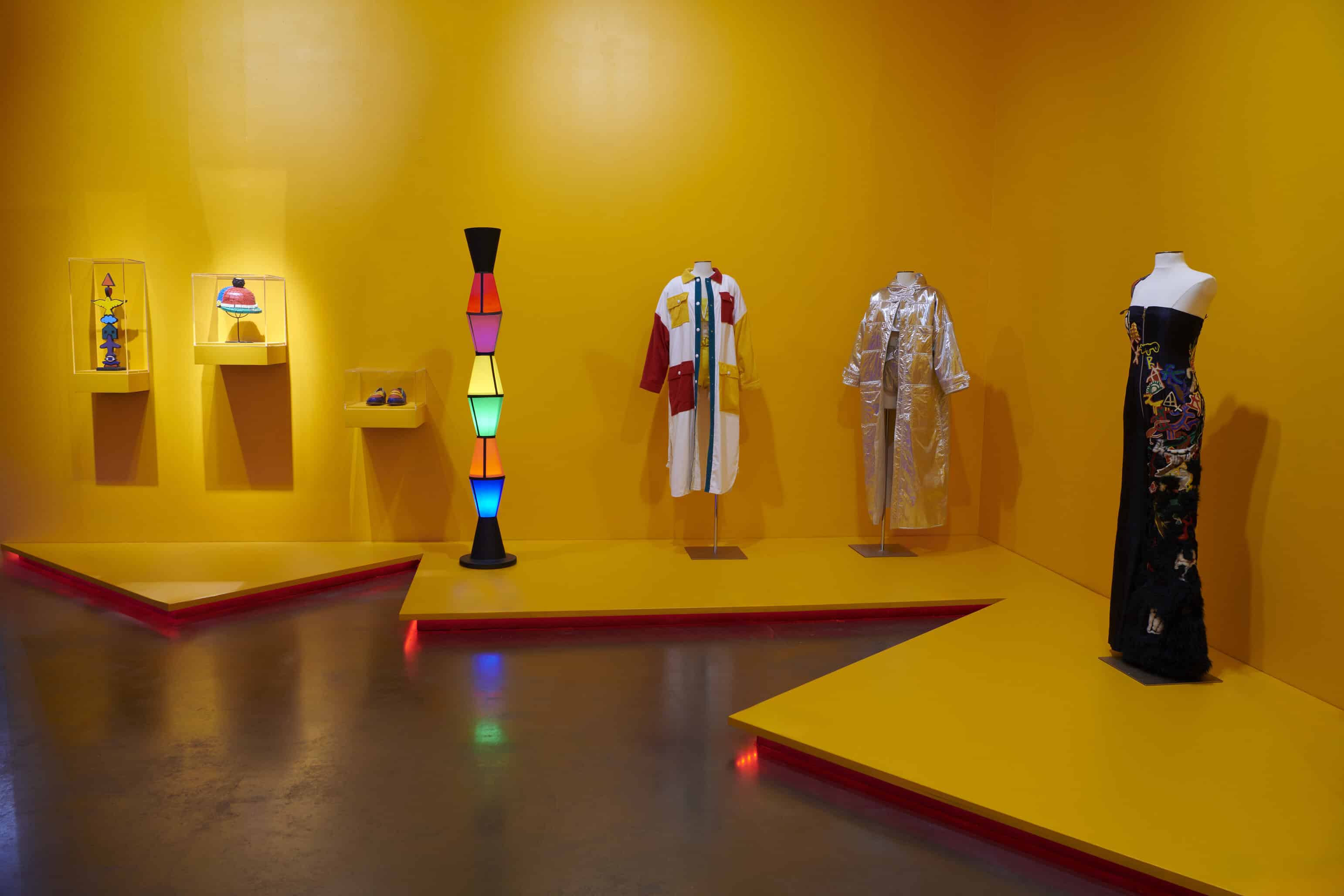

December 2025 to 23 August 2026. © JBE Books, Paris, 2026 and Les Abbatoires, Musée – Frac
Occitanie Toulouse, photo by Marc Domage
Fashion as an Artistic Medium: A Toulouse Exhibition
The fashion exhibition in Toulouse features a body of work that began in the late 1960s and continues to this day. Through the installations created especially for Les Abattoirs, the show takes visitors on a journey into the universe of Jean-Charles de Castelbajac.
His embrace of upcycling, collage, and hybridisation all place his work in dialogue with different art movements. In particular, this ranges from Arte Povera and New Realism to conceptual art. Clothing, drawings, photographs, design objects, and accessories reveal his ability to transform materials and ideas into spaces for artistic, historical, and social reflection.
Furthermore, Castelbajac never stops reinventing himself. For him, art and fashion have always been one and the same. As a result, this belief has led to an extraordinary series of collaborations. These have become his signature. Among others, these include names like Robert Malaval, Oliviero Toscani, Lady Gaga, and Max Mara.
All of this makes Castelbajac the perfect subject to open the first Les Abattoirs’ fashion exhibition in Toulouse.


A Universe in Three Acts
The Toulouse fashion exhibition unfolds across three key dimensions of Castelbajac’s practice. First, his drawings and collages reveal a restless visual language. Inspired by Dadaism and the legacy of Raoul Hausmann, he assembles words and photographs into bold, instinctive compositions. He calls collage “his rebellion”, a way to abolish the boundary between gesture and space. Then, his fashion work takes center stage. From coats cut out of blankets to accumulations of stuffed animals and pasta-shaped garments, his pieces transform the runway into a space for artistic statement. Finally, his photographic collaborations document a career built on dialogue. Since 1976, he has invited photographers such as Oliviero Toscani and Bettina Rheims to capture his world. Over time, he has assembled a gallery of artists and designers wearing his creations. Altogether, the creative journey is fully realized in this fashion exhibition held in Toulouse.

© Jean-Charles de Castelbajac

Castelbajac for Weston, 1994 © DR
Jean-Charles de Castelbajac
Jean-Charles de Castelbajac began his career in the late 1960s alongside his mother, co-founding Ko & Co. His first defining pieces were a coat cut from his boarding school blanket and clothes made from mops. Subsequently, he founded his own fashion house in 1978.
Between the 1970s and 1980s, he served as artistic director of several fashion houses. In particular, he co-founded Iceberg and invented its iconic cartoon sweaters. He collaborated with Max Mara, and later on, André Courrèges chose him to succeed him at the helm of his brand.
In addition, he initiated the blurring of boundaries between art and fashion through collaborations with different kinds of artists. He not only painted dresses with Miquel Barceló, Ben, and Robert Combas, but he also worked with Robert Mapplethorpe, Keith Haring, and Cindy Sherman on show invitations. Indeed, many of his most notable creations are now part of the fashion exhibition in Toulouse.
His iconic color palette of blue, yellow, and red defines most of his work. Most memorably, he expressed it in the vestments he designed for Pope John Paul II, bishops, and priests for World Youth Day in 1997.
In 2023, he received the Grand Vermeil medal from the City of Paris and created a collection for the Gien earthenware factory. Following this, the Diocese of Paris chose him to design the liturgical vestments for the reopening of Notre-Dame de Paris. Consequently, from December 2025 to August 2026, this fashion exhibition in Toulouse at Les Abattoirs is dedicating a major exhibition to his work.

Spring-Summer 1982, “Homage to Comic Books” collection © Bettina Rheims / Adagp, Paris, 2025
Share this post

emotional intelligence, she approaches culture as something to be felt as much as understood, moving fluidly between fashion, music, and the subtle codes that define identity across borders. At IRK, this instinct becomes editorial language, where curiosity is not surface-level but immersive, always searching for what sits beneath aesthetics.
With a background in e-commerce, Elena developed her understanding of digital strategy within a small, human-centered company, working closely alongside neurodivergent teams. The experience shaped her approach to communication and storytelling, grounding it in inclusivity, adaptability, and attention to nuance. These values inform her work at IRK, where content is not only created, but carefully considered in how it connects, resonates, and includes.
Read Next


