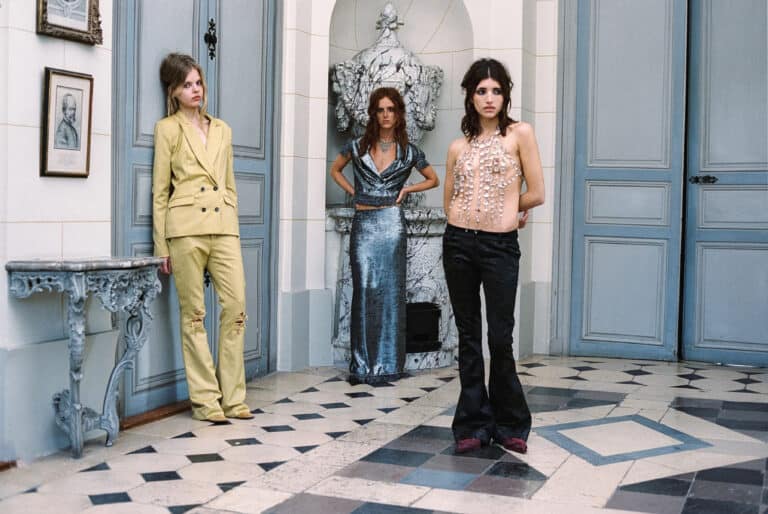

Raxada Project: The Living Memory of Craft
Gülsüm Tuğlu
Bridging ancestral craft and contemporary fashion design through the sartorial vision of Raxada Project
Based in the tranquil landscapes of Asturias, founders María and Marina create a thoughtful dialogue between ancestral memory and contemporary fashion through their apparel label, Raxada Project. After leaving the unrelenting pace of the fast-fashion circuit, they established their clothing studio to honor the generations of women who preserved textile knowledge through intuitive handcraft.
Rather than treating traditional lacework and stitching as relics of the past, the duo actively transforms these techniques into living, wearable garments. Consequently, every tailored silhouette balances conscious production with artistic intention. Below, the designers discuss slowing down the industry calendar, listening to natural surroundings, and redefining modern freedom through artisanal lineage.

IRK: By bridging heritage and contemporary design, how do you translate ancient craft into a modern aesthetic?
Raxada Project: As designers, we have spent years studying and researching ancestral and traditional craft techniques. This interest also comes from our own experience within the industry. After working in fast fashion, I realized I wanted a different career path. My work had to respect both environmental and social rhythms.
For us, craftsmanship is precisely that vehicle. It restores real value to the process and the materials. Above all, it honors the people behind each piece. We also understand craftsmanship as a form of cultural heritage that carries the identity, memory and history of our society.
We are very aware that many of these skills and processes face extinction. This loss is partly driven by an increasingly fast, standardized production system. Our aim is therefore to recover them and translate them into contemporary, relevant and genuinely wearable garments.
For us, this is a small revolution. We look to the past not through nostalgia, but as an active tool. It helps us imagine a more balanced, conscious, and sustainable future.

IRK: Rooted consciously in Asturias, how does the geographical and cultural heritage of your surroundings infiltrate your design methodology?
Raxada Project: We are designers who need fieldwork in order to create. Being in contact with nature is one of our main sources of inspiration and an essential part of our creative process.
We both lived in large cities and worked across creative industries. Returning to our region gave us essential physical and mental space. Here, we can freely develop our own design language.
Asturias is inevitably present in what we do.Its landscapes, culture, traditions, and childhood stories permeate our collections. This influence appears both consciously and intuitively. We do not try to represent Asturias literally. Instead, it lives in our imagination and naturally emerges in our designs.
IRK: What narrative thread connects traditional crafts like lacework and hand-stitching to your contemporary voice?
Raxada Project: We spent years exploring and learning different craft techniques. In our process, we combine these traditional forms of handwork. We then experiment with them to discover fresh applications.
Behind this work is a desire to honor both the processes and the women before us. These women created, learned, and passed this knowledge across generations. They often handed it down from mothers to daughters. For Marina and me, this shared knowledge is essential. We see transmission as preservation, and it remains an enormous inspiration.
Preservation cannot simply mean reproducing the past. As women and designers today, we safeguard these techniques by letting them evolve. We experiment, innovate, and translate them into a contemporary language. This ensures they remain vital in both the present and the future.

IRK: How do you balance slow, traditional craftsmanship against the unrelenting speed of the fashion calendar?
Raxada Project: This is a great question because it is undoubtedly one of our biggest challenges. Perhaps the fact that Raxada continues to grow is also part of the answer we are looking for.
It is not always easy to reconcile the time demanded by craftsmanship and conscious production. The fast pace of the fashion industry creates constant pressure. However, we strongly believe that proposing different ways of creating and consuming fashion is necessary. So, even when it feels as though we are swimmin against the current, Marina and I remain committed to this way of working.
We found balance by rethinking the business on our own terms. Very often, that meant unlearning conventional industry rules. We now define how our brand operates instead of following standard industry expectations.
We are still searching for that balance, and probably always will be. However, we have learned to trust our intuition and respect our own rhythms. This holds true even when doing things differently from the established system.
IRK: Your work balances preservation and invention. Do you view your garments as wearable heritage, or forward-facing contemporary design?
Raxada Project: For us, our designs have to be contemporary, functional and, of course, wearable. We are not interested in preserving the past by creating pieces that belong only to it. We want to translate that knowledge into garments that make sense in contemporary life.
Equally, we commit to creating pieces built for longevity in both construction and sentiment. We want our clothing to journey with the wearer over time and pass to new hands. Ultimately, each garment preserves the craft, memory, and human labor behind every stitch.
We are inspired by the past, but we design for the future.

IRK: How do you make room for the unpredictability and natural flaws of ancient crafts in your production process?
Raxada Project: Our garments are made in a small workshop in Asturias by women who understand and embrace the time required by artisanal processes and bring enormous care to every detail.
In our designs, we intentionally leave threads, hand stitches and certain traces of the making process visible. In our designs, we intentionally leave threads, hand stitches, and traces of making visible. We want each garment to reveal how it was made. We also want it to retain the marks of human hands. This apparent imperfection remains a deliberate aesthetic choice. Every finish and construction detail is executed with high quality and care
For us, the small variations that arise through handwork are not something to eliminate, but part of what gives each piece its identity and soul. Behind every garment there is time, knowledge and, above all, people.
We believe that this energy somehow remains within the pieces, and one of the most moving things for us
is seeing that our clients can perceive and deeply value it too.
IRK: There is a distinct musicality to your garments. How do sound and atmosphere translate into the way you drape a silhouette?
Raxada Project: We work from Asturias by choice. We need to step away from the noise of large cities, events and, in a way, the industry itself, in order to listen to and observe the world in our own way.
Our everyday lives are accompanied by the sounds of the sea, rivers, wind, birds and mountains. This is the soundscape in which we live and create. We may not always be fully conscious of how it translates into our designs, but we are certain that this atmosphere becomes part of the work.
We believe that this space and quiet allow us to work more intuitively, paying attention to movement, materials and the way a garment relates to the body. Sometimes, moving away from the noise is precisely what allows you to find your own voice.

IRK: As your artisanal pieces enter the global spotlight, how do you protect their intimacy from the demands of international visibility?
Raxada Project: We understand fashion as an art form that intertwines with other disciplines to build new universes and contemporary narratives. We deeply cherish our collaborations with fellow women creators who shape new visions of the world through our shared values of care, sensitivity, and collaboration.
For this reason, creating performance and stagewear is a dream for us. It allows us to take our language into other territories and contribute to the imagery of projects that have their own sound, movement and narrative.
These collaborations have developed very organically and, at the same time, have introduced Raxada to new audiences and markets that value the creative and artisanal work we do. There is something very special to us about that synchronicity: we do not feel that we need to transform our work in order to reach a more global audience; it is precisely our identity and our way of creating that are generating those connections.
That is why we feel our costume work and the commercial development of Raxada nourish one another and
coexist in a very natural and balanced way.
IRK: As part of Fashion Scout’s Ones to Watch cohort, what specific conversation surrounding
sustainability and heritage do you aim to ignite on the London Fashion Week stage?
Raxada Project: This collection begins with a very personal idea: “We are our grandmothers’ dreams.”
For generations, womanhood was defined by very specific expectations: to be a wife, a mother and a caregiver. Pleasure, adventure, ambition, or simply the freedom to build a life of one’s own, often existed
outside that definition.
For this collection, we looked to the clothes the women in our families wore to step out into the world: to celebrate, dance, travel and enjoy themselves. Marina and I belong to the first generation in our families able to pursue creative careers, travel and move through the world independently, and build lives shaped by our own decisions.
When we approach heritage, we do not simply preserve techniques or textiles; we carry forward the stories of the women who came before us and reshape that legacy with our own contemporary freedoms.
Presenting this collection at London Fashion Week is a way of connecting their stories with our own and celebrating the fact that there is no single way to be a woman. For us, sustainability and heritage also mean this: caring for what we receive from the past, transforming it and allowing it to continue living into the future.

Share this post

I approach editorial storytelling from a dual perspective: a foundation in industrial engineering paired with a deep immersion in visual culture and fashion journalism. This background allows me to dissect creative narratives with both analytical clarity and intuitive curiosity.
My work explores the intersections of contemporary art, innovative craft, and design. Through in depth artist features, material explorations, and cultural critique, I focus on capturing the subtle friction between technical mastery and unrestricted aesthetic expression.
Read Next