

Emily Frances Barrett : Raw Beauty, Radical Craft
Mila Jaso
Emily Frances Barrett reveals the poetic alchemy of her work, transforming raw nature into wearable sculpture.
London based artist Emily Frances Barrett redefines contemporary jewellery by turning adornment into narrative sculpture. With a background in illustration, she first created the Chapman brothers’ infamous dark dioramas. She then transformed this unconventional path into a distinctive creative practice. Emily rejects the conventions of mass market luxury and works instead with butterfly wings, porcupine quills, and discarded fragments. She handles each material with precision and respect. As a Sarabande Foundation alumna, she continues the creative legacy of Lee Alexander McQueen. Her work challenges industrial uniformity through instinct, craftsmanship, and personal expression. In this conversation, Barrett explains how each piece preserves memory and celebrates individuality.

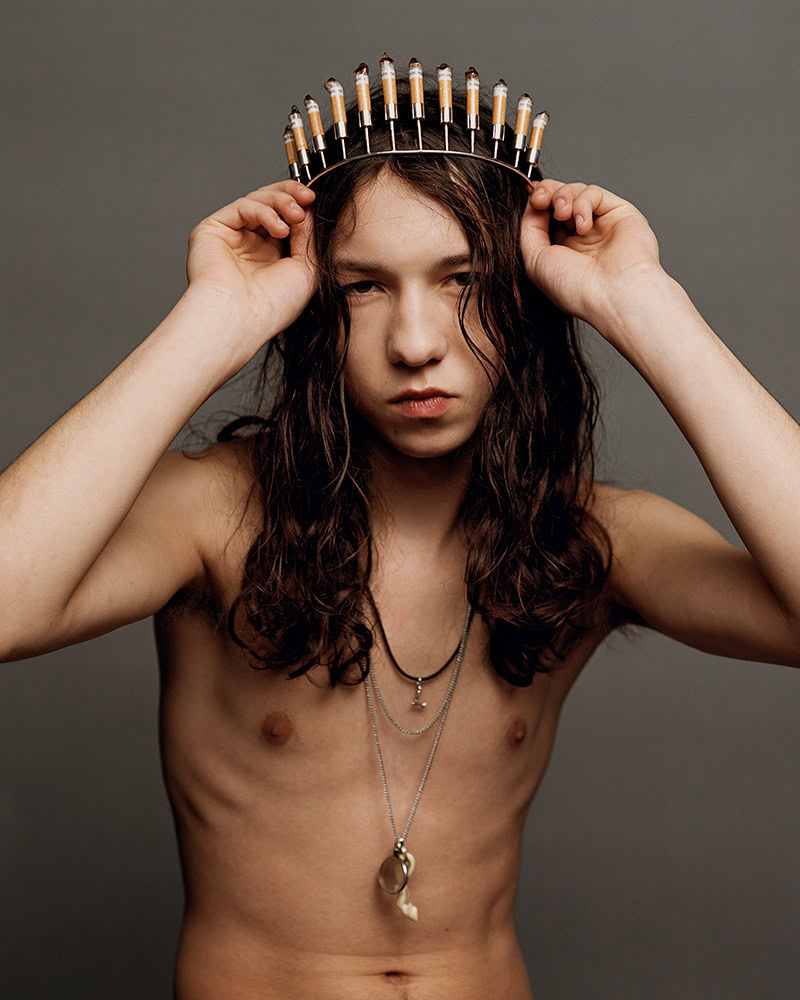
IRK: To put it simply, how would you describe your creative process to someone who has never seen your work?
Emily Frances Barrett: My creative process is instinctual. As a self taught designer, I developed my own way of working instead of following a traditional process or a well worn path.
I do not follow a fixed creative rhythm because creativity ebbs and flows. I capture ideas when they come and focus on other things when they do not.
Materials are often a starting point for me. Something that already exists, a natural object or something that’s had a past life seems to spark my imagination.
IRK: What is the core idea behind transforming raw, natural objects into wearable art?
Emily Frances Barrett: I assign my own value to materials and objects instead of letting others define it. Many people want their jewellery to reflect their wealth above all else. As a result, conspicuous consumption dominates much of the jewellery world.
For me, taste, style and originality are far more important than displaying wealth to demonstrate your bank balance and social standing! It seems utterly pointless to own jewellery that costs the world and yet is completely unoriginal. Once you do away with the idea that jewellery must hold inherent monetary value, you’re free to express your own ideas of beauty, style and ultimately your values!


Your work transcends standard jewelry, functioning more as a sculpture that defies conventional boundaries. Naturally, could you share the story behind your creative journey?
Emily Frances Barrett: Even as a really young kid I always expressed myself through ‘making’ and creating things, so it’s in my blood.
Though I started my formal creative education studying Illustration. Here I discovered I work best creating in 3D with my hands, and began making detailed miniature worlds and dioramas.
After graduating, I began assisting set designers and making props for fashion sets. Shortly afterwards, Jake and Dinos Chapman offered me a job. I moved to London to work for the infamous art duo. For four years, I worked on their Hellscapes. These were 3D miniature dioramas depicting everyone who should be in hell.After the Chapmans, I studied an MA in Fashion Communication and Promotion at Central Saint Martins. I was interested in fashion as a platform for storytelling. I wrote my dissertation about Jewellery, and it was then I decided I wanted to teach myself silversmithing and start exploring Jewellery as a medium.
After CSM I was offered an art residency at Sarabande, The Lee Alexander McQueen Foundation. It was here, in my first studio space, that I really began to focus wholly on my own art and jewellery practice.
That has pretty much been my creative path, and one am very grateful to still be on 8 years later. This meandering journey, peppered with an array of tangents, interests and creative skills means there’s often a-lot of cross-pollination going on in my work. At times the journey has frustrated me, but now I really do see the value in the many twists and turns.

What triggered this desire to move away from traditional design and explore such an unconventional path?
Emily Frances Barrett; There was no trigger, the unconventional path has always been mine. In that sense it’s who I am, therefore my journey and what I create is completely normal to me, it simply reflects what I value; craftsmanship, innovation, uniqueness, individualism and independence.
Working with fragile fragments, from butterfly wings to porcupine quills, demands a specific touch. In this process, how do you approach these sensitive elements without violating their natural essence?
Emily Frances Barrett: With great care! I never try to change such materials if at all possible. I try my best to work around them and celebrate what’s already there.
You create art that exists entirely outside standard industry trends. However, what is the specific emotional response you hope to trigger when a person first touches your jewelry?
Emily Frances Barrett: I don’t really hope for any specific emotional response, as people will respond in a way regardless. But I guess I’d like my work to inspire people, and perhaps spark their imagination.

We live in an era of mass-produced, ephemeral accessories. Consequently, do you view your role as an artist as a form of resistance against industrial uniformity?
Emily Frances Barrett: Not my ‘role’ as such, but art and things made with by the human hand certainly offers an antidote to that. It’s been a considered and privileged choice to pursue art and creativity as a way to make a living, but I believe the compulsion to make art is what makes a true artist, and that is not a choice.
I see my role as an artist as a responsibility, to choose the right ideas to bring to life, and to make them to very best of my ability.
Every piece you craft tells a story of preservation. If your work were to communicate one singular message to humanity, what would it be?
Emily Frances Barrett: “We were here!”
I see the used materials I work with as fragments of time, broken, cracked or worn down by the lives they’ve seen. Similarly, Jewellery too is marked by the wearer, leaving traces of themselves in the metal. I like the idea that every physical piece of work I make, will one day speak of our existence.

Share this post

I grew up in a house divided between two worlds, the tennis court and the front row. For years, high-level competition was everything, until an injury forced me to stop and ask a different question. The answer led me to art direction and communication, and something clicked. It felt less like a change of path and more like arriving at the one I was always meant to take.
I believe fashion is never only about clothes. It is the silhouette you choose, the way you walk into a room, the story you bring to a piece of fabric, whether you intend it to or not.
For me, pursuing the intersection of fashion and art direction is the natural expression of that belief. A space where visual language and creative storytelling become one.
Read Next


